⚡ Quick Answer
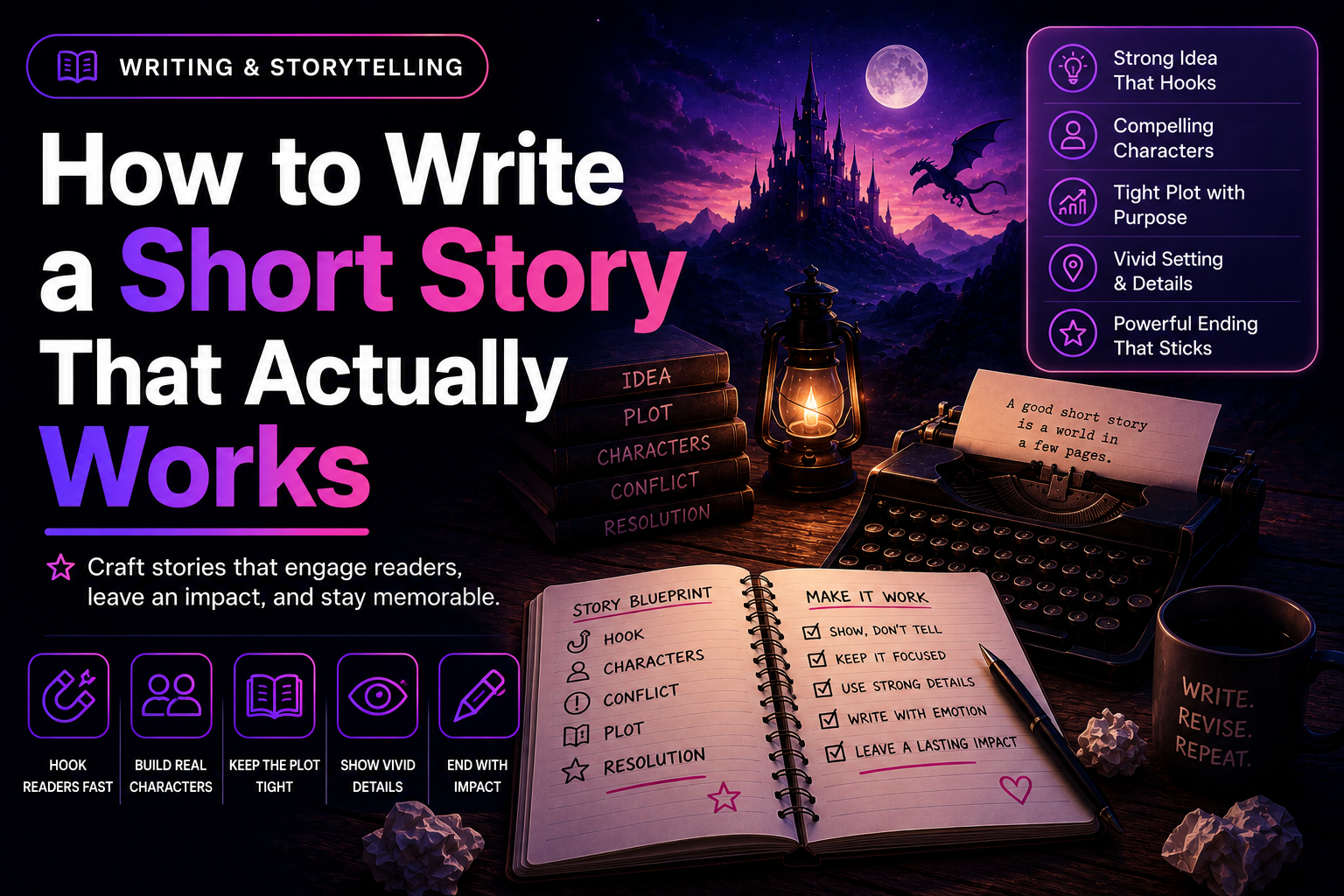
Learning how to write a short story starts with narrowing the scope: one central conflict, a small cast of characters, and a single point of view are usually enough to fill the form well, since a short story succeeds by doing one thing precisely rather than many things loosely. The most common mistake new writers make is treating a short story like a compressed novel, packing in a full cast and multiple subplots that the format simply doesn’t have room for.
Short stories reward precision in a way longer fiction doesn’t always demand, since every scene, and often every sentence, has to earn its place in a much smaller space. This guide walks through how to write a short story that actually holds together, from choosing a workable idea through revising a finished draft.
None of this requires years of practice to apply. The core principles of short fiction are learnable, and understanding them upfront saves a lot of trial and error on early attempts.
Start With a Single Idea, Not a Whole World
A short story built around one clear idea, a decision, a realization, a single pivotal event, tends to work better than one trying to explore an entire fictional world or a character’s whole life story. The format simply doesn’t have room for everything a novel can hold.
That single idea can be small: a phone call that changes a relationship, a decision made under pressure, a single afternoon that reveals something about a character. The scope should feel proportional to the length, since an idea big enough for a novel usually leaves a short story feeling rushed and underdeveloped no matter how well it’s written.
Limit the Cast of Characters
Short stories generally work best with a small cast, often just one or two characters who actually matter to the plot, plus a handful of minor figures who exist only to serve a specific scene. Every additional character who needs backstory and development eats into space the format doesn’t have.
This doesn’t mean secondary characters need to feel flat. It means their role should be narrow and clear: a single function within the story rather than a full arc of their own. Readers can only track so much in a few thousand words, and a focused cast keeps that tracking effortless.
Enter the Story as Close to the Conflict as Possible
Short fiction rarely has room for a slow build-up the way a novel does. Starting close to the story’s central tension, sometimes in the middle of the inciting action itself, gets a reader invested before the format runs out of space to develop anything else.
This technique, often called starting in medias res, doesn’t mean skipping context entirely. It means trusting that necessary background can be woven in through action and dialogue rather than delivered upfront in a slow, scene-setting opening that a short story usually can’t afford.
Give the Story One Clear Turning Point
Where a novel can sustain multiple major turning points across several subplots, a short story generally works best built around a single pivotal moment, the point where something shifts for the protagonist and can’t be undone.
That turning point doesn’t need to be dramatic in an external sense. A quiet internal realization can carry as much weight as a major external event, provided the story makes clear that something has genuinely changed by the final page. Stories that end exactly where they began, with nothing shifted, tend to feel unfinished even when they’re technically complete.
Use Dialogue and Action Instead of Exposition
Short stories have limited space for lengthy exposition, so showing character and context through dialogue and action tends to work more efficiently than explaining it directly. A single well-chosen line of dialogue can reveal more about a relationship than a paragraph describing it.
This is closely related to the broader writing principle of showing rather than telling, but it matters more acutely in short fiction, where every explanatory paragraph is space that could otherwise be spent developing the story’s single central idea.
Write a Complete First Draft Before Revising
Even at short-story length, writing the full draft before going back to revise individual sentences remains sound advice. It’s tempting to polish the opening paragraph repeatedly in a shorter piece, but that habit still slows momentum the same way it does in longer fiction.
A short story’s compact length actually makes this easier to manage than a novel, since a complete rough draft is often achievable in a single sustained writing session, or across just a few. Getting the whole arc down first makes revision far more effective, since changes to the ending can be reflected in the opening without hunting through hundreds of pages.
Choose an Ending That Resonates Rather Than Resolves Everything
Short story endings don’t need to tie up every loose thread the way a novel’s conclusion often does. A short story that ends on a resonant image, an unresolved but meaningful moment, or a small but genuine shift in the protagonist’s understanding, can feel more complete than one that answers every question.
This is one of the format’s genuine strengths: short fiction can end on ambiguity in a way that would frustrate readers in a full novel, provided the ambiguity feels intentional rather than like the story simply ran out of room to finish.
Revise for Compression, Not Just Correction
Editing a short story involves a specific skill beyond fixing typos and awkward sentences: cutting anything that doesn’t serve the central idea, even material that’s well-written on its own. A beautiful paragraph that doesn’t advance the story or reveal character is still a candidate for cutting.
This compression pass often shortens a draft significantly, and that’s usually a sign of a stronger final story rather than a weaker one. Short fiction rewards density, where every remaining sentence carries more weight because there’s nothing extraneous around it.
Read Published Short Stories in the Target Genre
Studying how established short story writers handle pacing, structure, and endings within the format’s tight constraints remains one of the fastest ways to internalize what actually works. Literary magazines, genre anthologies, and single-author collections all offer different approaches worth studying.
Paying attention to where a published story chooses to start, what it leaves out entirely, and how it ends without over-explaining, tends to teach short-form craft more effectively than writing advice alone, since it shows the principles in practice rather than in the abstract.
Choosing a Point of View That Fits the Story
First person and close third person are the two most common choices for short fiction, both because they keep the reader tightly anchored to one character’s perspective within a format that has no room for a wandering, omniscient narrator to establish itself.
First person suits stories built around a distinctive voice or a strong internal reaction to events, while close third person offers slightly more flexibility for moments the narrator wouldn’t naturally say out loud. Neither choice is inherently better; the right one depends on whether the story’s power comes more from voice or from observed detail.
Setting the Right Pace for a Short Length
Pacing in a short story compresses everything a novel would spread across many chapters into a handful of scenes, which means every scene has to move the story forward more efficiently than a novel scene typically needs to.
This doesn’t mean every short story has to move quickly in a literal sense; a quiet, slow-paced story can still work well. It means every included moment has to justify its place, since there’s no room for a scene that exists purely for atmosphere without also doing narrative work.
Common Mistakes When Writing a Short Story
The most common mistake is scope: cramming a novel’s worth of plot and characters into a few thousand words, which leaves everything feeling rushed rather than precise. A short story succeeds by doing less, not by compressing more.
Another frequent misstep is an ending that either resolves too neatly, undercutting the story’s tension, or trails off without any sense of a genuine shift having occurred. Both extremes tend to leave readers feeling like the story didn’t quite land, even when the writing along the way was strong.
Turning Short Stories Into a Published Collection
Authors who write several short stories often eventually want to compile them into a single published collection, which introduces a different set of considerations than a standalone story does, consistent formatting, a working table of contents, and a cohesive theme or throughline connecting the pieces.
Platforms like Ebookerr handle that formatting step directly, letting an author import multiple finished stories and export them as a single, properly structured EPUB, PDF, or Word file ready for Amazon KDP or other ebook stores. For authors interested in the fuller publishing process once a collection is ready, how to write an ebook covers the steps that follow a finished manuscript.
Frequently Asked Questions
How long should a short story be?
Most short stories run between 1,000 and 7,500 words, though the exact range varies by publication and genre.
Can a short story have more than one point of view?
It’s possible, but a single point of view is generally easier to manage well within the format’s limited space.
Does a short story need a twist ending?
No. A twist can work, but a quieter, resonant ending often serves the story better than a forced surprise.
How is writing a short story different from writing a novel chapter?
A short story is a complete, self-contained arc, while a novel chapter depends on surrounding chapters for full context.
Is first person or third person better for a short story?
Neither is universally better; the choice depends on whether the story relies more on voice or on observed detail.
Final Thoughts
Writing a short story well comes down to precision: one clear idea, a focused cast, and an ending that resonates rather than over-explains. Once a story or a full collection is finished, turning it into a published ebook is a separate step, and Ebookerr handles that formatting and export process directly. For more on that stage, see how to write an ebook or how to sell ebooks once the manuscript is ready.