⚡ Quick Answer
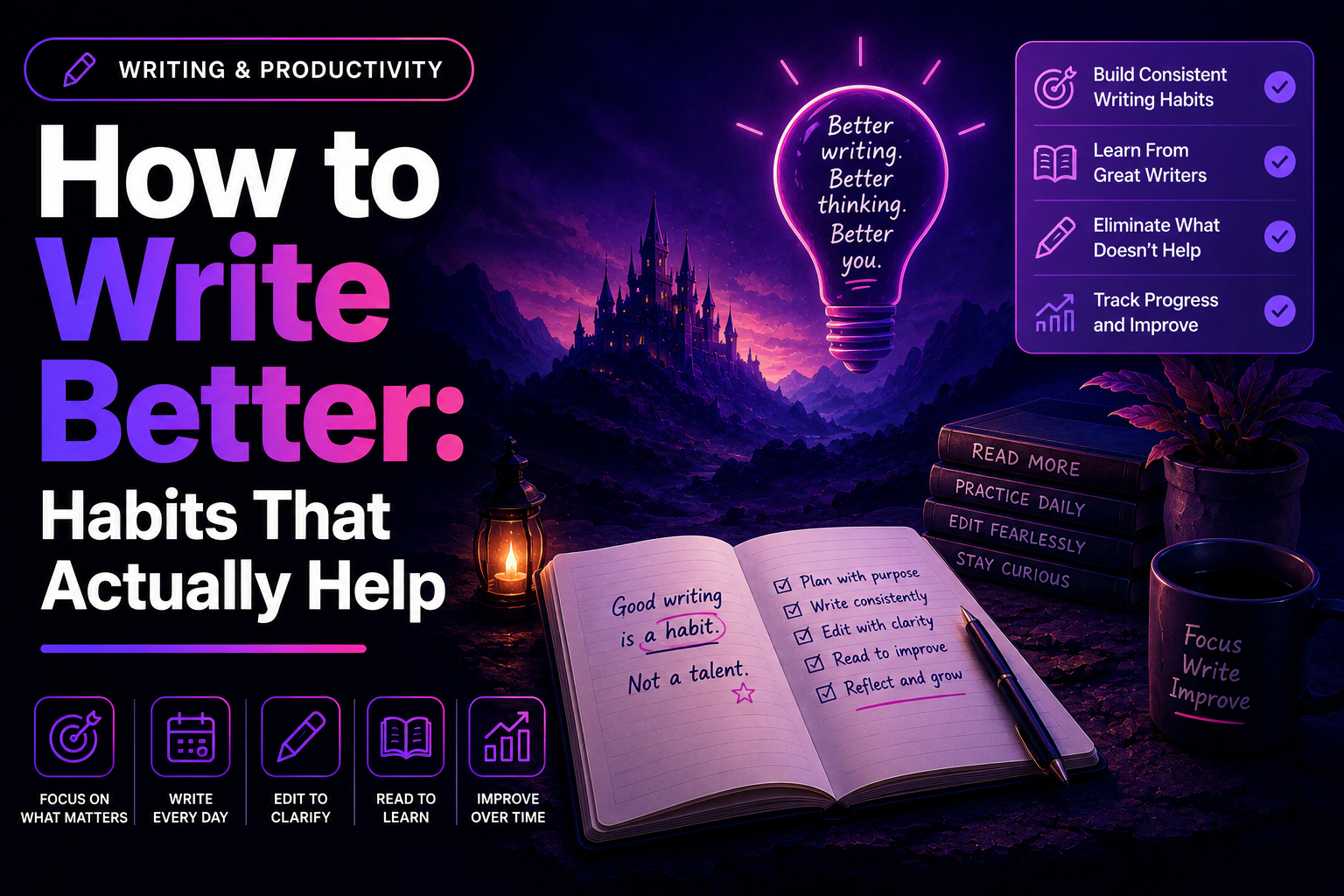
Learning how to write better comes down to a small set of repeatable habits: writing consistently rather than waiting for inspiration, reading with attention to craft rather than just story, cutting unnecessary words during revision, and actively seeking feedback instead of avoiding it. Improvement in writing rarely comes from a single breakthrough; it comes from steadily applying these habits across enough pages that better instincts start to form on their own.
Most advice about writing better focuses on abstract qualities like voice or style, but the writers who actually improve tend to rely on concrete, repeatable habits instead. This guide covers the practical changes that move writing from adequate to genuinely strong, regardless of genre or format.
None of these habits require special talent to apply. They’re learnable skills, and consistent practice matters more than any single piece of advice on this list.
Write Consistently, Even When It Feels Mediocre
The most reliable way to improve as a writer is simply writing often, even when a given session produces work that feels unremarkable. Skill develops through repetition, and skipping sessions until inspiration strikes slows that development considerably.
A consistent practice doesn’t need to be long. Twenty minutes of focused writing most days builds more skill over a year than occasional multi-hour sessions separated by long gaps, since the brain strengthens the specific patterns involved in writing through frequent, spaced repetition rather than infrequent bursts.
Read With Attention to How, Not Just What
Reading widely helps every writer, but reading actively, noticing how a favorite author builds tension, structures a sentence, or handles a transition, teaches craft far more directly than reading purely for the story does.
This kind of close reading doesn’t need to be academic. Pausing occasionally to ask why a particular paragraph worked, or why a scene felt slow, builds an intuitive sense of technique that eventually shows up in a writer’s own work without conscious effort.
Cut Unnecessary Words During Revision
Nearly every first draft contains more words than the final version needs. Learning to identify and cut filler, redundant phrases, unnecessary qualifiers, scenes that repeat information already established, is one of the fastest ways to make writing feel tighter and more confident.
This doesn’t mean every sentence needs to be short. It means every word needs to justify its place, and a revision pass focused specifically on cutting, rather than just fixing typos, tends to produce a noticeably stronger draft than one focused only on correctness.
Vary Sentence Length and Rhythm
Writing made up entirely of similarly structured, similarly lengthed sentences tends to feel monotonous, even when each individual sentence is well-constructed. Mixing short, punchy sentences with longer, more complex ones creates rhythm that keeps readers engaged.
This is one of the more mechanical improvements a writer can make relatively quickly, since it’s a matter of noticing a pattern and consciously varying it, unlike broader skills like plotting or characterization that take longer to develop.
Seek Feedback and Actually Use It
Writers who improve fastest tend to be the ones willing to share unfinished, imperfect work and genuinely consider the feedback they get, rather than only seeking praise or dismissing criticism that’s uncomfortable to hear.
Useful feedback isn’t always comfortable, but it’s specific: what confused a reader, where their attention drifted, what didn’t land the way it was intended to. Writers who only ask “did you like it” tend to get less useful feedback than those who ask more targeted questions about specific sections.
Study Grammar and Mechanics, Then Learn When to Break the Rules
A solid grasp of grammar and sentence mechanics gives a writer more control over their prose, even in styles that deliberately bend or break conventional rules. Fragment sentences, unconventional punctuation, and stylistic repetition all work better when they’re clearly intentional choices rather than accidents.
This is part of why studying the rules first, then learning when departing from them serves the writing, tends to produce more confident, effective prose than either rigid rule-following or undisciplined rule-breaking on its own.
Write in Different Formats and Styles
Trying formats outside a writer’s usual comfort zone, poetry for a prose writer, dialogue-heavy scenes for someone who favors description, short pieces for a novelist, tends to reveal blind spots that stay hidden when writing only in one familiar mode.
This kind of deliberate range-building doesn’t need to lead anywhere published. The goal is developing flexibility and noticing which techniques from an unfamiliar format might strengthen the writer’s primary work once they return to it.
Eliminate Weak, Vague Language
Certain words and phrasing patterns weaken writing reliably: vague adjectives like “very” or “really,” passive voice used without a specific reason, and abstract statements where concrete detail would land harder. Learning to spot these patterns during revision sharpens prose noticeably.
This isn’t about eliminating every instance of these patterns entirely, since they’re sometimes the right choice. It’s about using them deliberately rather than by default, which requires noticing them in the first place, something that gets easier with practice.
Set Specific, Measurable Improvement Goals
Vague goals like “get better at writing” are harder to act on than specific ones like “reduce adverb use in dialogue tags” or “vary paragraph length more in this chapter.” Specific goals give a revision pass something concrete to check for.
Rotating through a short list of specific goals across successive projects, rather than trying to fix everything at once, tends to produce steadier improvement than attempting a complete overhaul of every weakness simultaneously.
Use AI Tools as a Practice Partner, Not a Shortcut
AI writing tools can support the improvement process in specific ways: generating alternate phrasings to compare against an original sentence, offering a second perspective on unclear passages, or helping draft a rough version of a difficult scene that gets rewritten in the author’s own voice afterward.
Platforms like Ebookerr combine AI-assisted drafting with the formatting tools needed to turn finished writing into a properly structured ebook once a project is ready, which makes them useful both during the improvement process and at the finished-manuscript stage. For authors applying these skills to a full book-length project, how to write an ebook covers what comes after the writing itself improves.
Build a Habit of Rewriting, Not Just Editing
Editing tends to mean fixing what’s already on the page, while rewriting means being willing to throw out a passage entirely and start it fresh if the first version isn’t working. Writers who improve fastest are usually comfortable doing both, rather than treating every draft as something to be patched rather than rebuilt.
This distinction matters most for passages that feel technically correct but still flat. A scene with no grammar errors can still fail to land emotionally, and no amount of line-editing fixes that; sometimes the honest fix is deleting the passage and writing it again from a different angle.
Learn From Editors and Critique Partners Over Time
A single round of feedback teaches something about one piece of writing. Working with the same editor or critique partner across multiple projects teaches something more valuable: the patterns in a writer’s own habitual mistakes.
Over several rounds, feedback starts to repeat in recognizable ways, too much exposition in openings, dialogue tags that overexplain tone, pacing that speeds up too quickly near the end. Recognizing those personal patterns is often more useful long-term than any single piece of feedback on an individual manuscript.
Common Mistakes That Slow Down Improvement
The most common mistake is avoiding feedback entirely, since writing in isolation without any outside perspective makes blind spots much harder to notice and correct. A writer’s own sense of what’s working can only improve so much without external input.
Another frequent misstep is chasing style before mastering fundamentals, attempting an distinctive voice before the underlying mechanics, clarity, pacing, structure, are solid. Style built on shaky fundamentals tends to read as inconsistent rather than distinctive.
Track What Actually Helped Across Projects
Keeping a short, ongoing note of which specific changes made a noticeable difference, a particular revision technique, a book on craft, a specific piece of feedback, turns scattered improvement into something a writer can deliberately repeat on the next project.
This is a simple habit that’s easy to skip, but without it, useful lessons from one project often don’t carry forward cleanly into the next. A writer who notices that cutting dialogue tags improved a scene’s pacing benefits from writing that down somewhere they’ll actually revisit before starting the next manuscript.
Frequently Asked Questions
How long does it take to notice improvement in writing?
It varies, but consistent practice with active feedback often shows noticeable improvement within a few months.
Is reading as important as writing for getting better?
Yes. Active, attentive reading builds craft awareness that pure writing practice alone doesn’t fully develop.
Should a beginner focus on grammar or creativity first?
Both matter, but a basic grasp of grammar gives creative choices more intentional control over the final result.
Can AI tools help someone become a better writer?
Yes, when used to practice alternate phrasing or get a second perspective, rather than as a full replacement for writing.
What’s the difference between editing and rewriting?
Editing fixes what’s already on the page; rewriting means starting a passage over when the underlying approach isn’t working.
Final Thoughts
Writing better comes down to consistent, repeatable habits: regular practice, active reading, disciplined revision, and a genuine openness to feedback. Once writing skills are strong enough to produce a finished manuscript, turning it into a published ebook is a separate step, and Ebookerr handles that formatting and export process directly. See how to write an ebook for more on that stage specifically.