⚡ Quick Answer
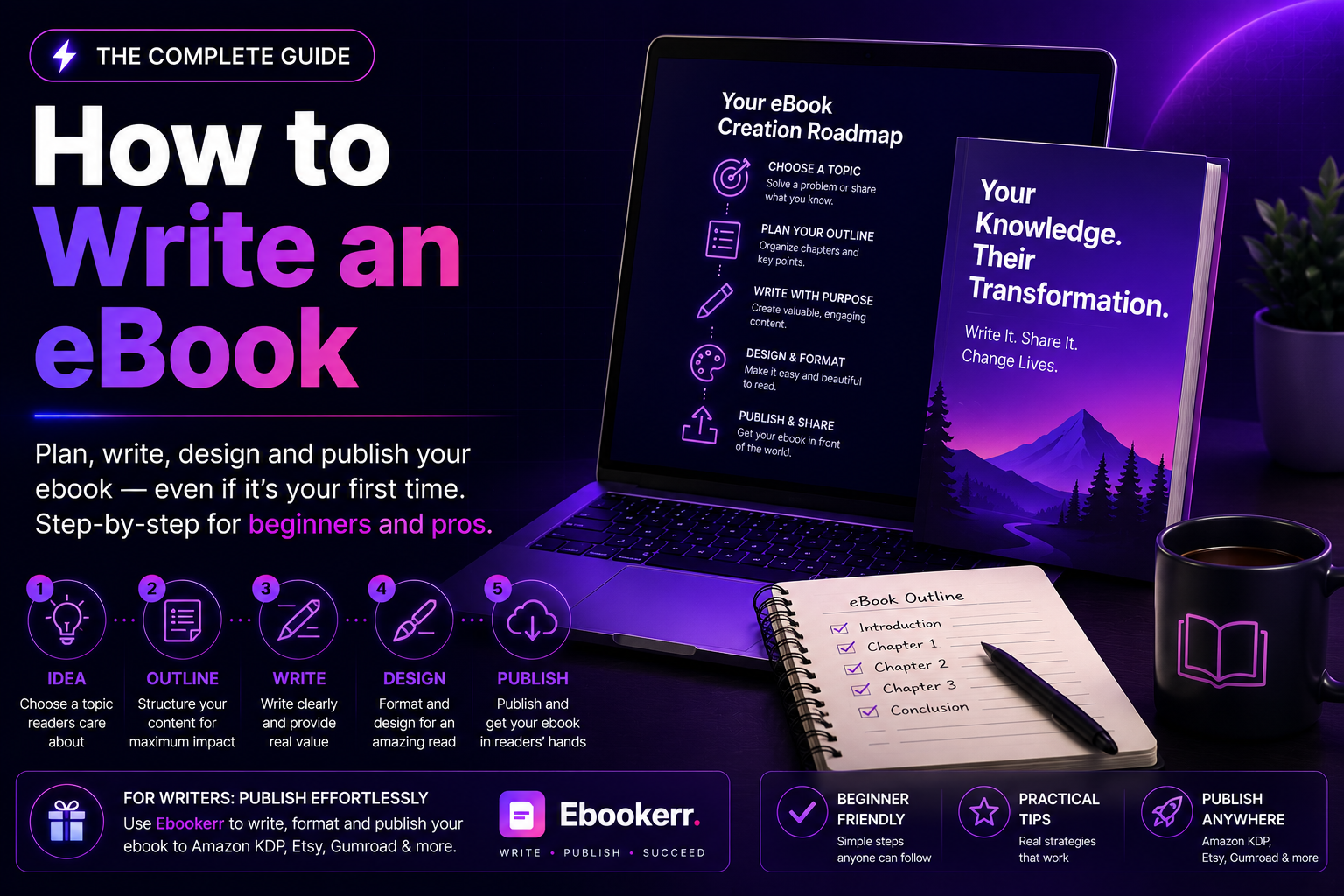
Learning how to write an eBook begins long before drafting your first page, requiring a focused topic, a clearly defined target reader, and a simple outline. Short, consistent writing sessions work much better than waiting for inspiration to strike. Once the manuscript is finished, it must be carefully edited, professionally formatted, and finally published. The sections below walk through each stage of the process in detail.
Many aspiring authors want to write an ebook but aren’t sure where to start. That’s a common starting point. Every published author once stared at a blank page, wondering how to turn an idea into a finished book. Learning how to write an ebook is a skill anyone can develop, as long as a clear process is followed and the writer sticks with it.
This guide breaks the process down into manageable steps. It covers how to pick a topic, plan the content, write consistently, and prepare a manuscript for publishing. Whether the goal is a short guide or a full-length novel, these steps help a writer finish what they start.
What Is an eBook (and Why Write One)?
An ebook is simply a book in digital format. Readers can open it on a phone, tablet, e-reader, or computer. Unlike a printed book, there’s no printing cost, no warehouse, and no shipping delay. An author can write it, format it, and publish it, often within a matter of weeks.
Ebooks are popular for a reason. They’re cheaper to produce than print books, quicker to update, and easier to distribute worldwide. For businesses, learning how to write an ebook can build authority and generate leads. For individual authors, it can create a new income stream or simply share knowledge with a wider audience.
Whatever the reason for writing one, the process is largely the same.
Step 1: Choose the Right Topic
Before a single word is written, the topic needs to be clear. A focused topic is easier to write and easier to market than a vague one. A good starting point is thinking honestly about what the writer knows well enough to teach or explain to someone else, what real problem the book would solve for a reader, and whether people are actively searching for that kind of help.
A narrow, specific topic almost always beats a broad one. “How to train a puppy not to bark” will serve readers better, and rank better in search results, than a generic book simply titled “Dog Care.” The more specific the topic, the easier it becomes to understand how to write an eBook with confidence, and the easier it is for the right readers to find the book.
When it’s unclear whether a topic has an audience, it helps to research it first. Looking at the questions people ask in forums, social media groups, and search engines related to the subject reveals what readers actually want to know, rather than what a writer assumes they want.
Step 2: Understand the Target Reader
Every strong ebook is written for someone specific. Before outlining a single chapter, it helps to picture the ideal reader: what they already know, what they’re struggling with, and what tone they’ll respond to, whether that’s casual and friendly or formal and professional.
Writing with a specific reader in mind keeps the tone consistent and the content relevant. It also helps avoid a common mistake: trying to write for everyone, and ending up connecting with no one.
Authors who already have an audience, such as a newsletter list, a blog, or social media followers, often find their best material in the questions that audience asks directly. Real reader questions tend to reveal exactly what’s missing from the information already available.
Step 3: Create an Outline Before Writing Begins
Skipping the outline is one of the biggest reasons unfinished ebooks pile up in a folder somewhere. An outline gives a writer a map. Without one, it’s easy to get stuck staring at a blank page, unsure what comes next.
A simple structure works well: an introduction that explains what the book covers and who it’s for, followed by main chapters, each built around one core idea rather than several loosely connected ones, and a conclusion that summarizes the key points and gives the reader a clear next step.
Each chapter can be broken down into three to five subtopics. A writer doesn’t need to know every sentence in advance, just enough structure to always know what comes next when it’s time to write. An outline also speeds up the writing process, because instead of figuring out what to say while drafting, the writer is simply filling in details that were already planned.
Step 4: How to Write an eBook Chapter by Chapter
Once the outline is ready, the real work of writing an ebook begins. The key is consistency, not speed. A little progress every day adds up faster than waiting for a burst of inspiration that may never come.
Setting a daily or weekly word count goal that fits the writer’s schedule helps build momentum. Even 300 to 500 words a day adds up to a full draft in a few weeks. It’s usually best to write one chapter at a time instead of jumping between sections, finishing a rough version of each chapter before moving to the next. Editing while drafting tends to slow things down, since editing and writing use different parts of the brain, and mixing the two makes it harder to finish.
The outline should be treated as a guide, not a cage. If a chapter naturally goes in a slightly different direction than planned, that’s fine. The outline exists to help, not to restrict.
Many new authors ask how to write an ebook without losing motivation halfway through. The honest answer is that motivation fades for everyone. What keeps a project alive is a routine: a set time, a set place, and a habit of showing up, even on days when the writing feels slow.
Step 5: Keep the Writing Clear and Readable
Readers skim. They don’t read every word of a digital book the way they might a printed novel on a quiet afternoon. That means clarity matters more than clever phrasing.
Short sentences work best, along with paragraphs broken into two or three sentences each. Plain words are usually a better choice than complicated ones, and anyone learning how to write an eBook will find that reading a draft out loud often reveals sentences that sound awkward and need a rewrite.
This doesn’t mean the writing has to be dull. Clear writing can still carry personality and voice. It just means readers aren’t made to work harder than necessary to understand the message.
Step 6: Edit and Proofread the Manuscript
Once the first draft is finished, it helps to set it aside for a few days if possible. Coming back with fresh eyes makes it much easier to spot weak sections, repeated ideas, and sentences that don’t quite work.
Editing usually happens in a few passes. A structural edit checks whether each chapter flows logically into the next and whether anything feels missing or out of order. A line edit tightens sentences and smooths out tone. A final proofread catches spelling, grammar, and formatting errors line by line.
When budget allows, hiring a professional editor is worth considering, even for a short ebook. A second pair of eyes catches things a writer, who has read the same pages dozens of times, tends to miss. When hiring an editor isn’t an option, a few trusted readers can review the draft and offer honest feedback before publication.
Step 7: Design and Format the eBook
A well-written ebook still needs to look professional. Formatting affects how readers experience the content, and a messy layout can undermine even excellent writing.
At a minimum, an ebook needs a clean, readable font with consistent heading styles throughout, along with a simple, professional cover design. It also needs correct formatting for whichever file type is used for publishing, whether that’s EPUB, PDF, or MOBI, and any internal links, such as a table of contents, need to work properly.
Advanced design skills aren’t required to get this right. Template-based tools can handle layout and cover design automatically, which is useful for writers exploring How to Write an eBook who want a polished result without hiring a designer. Ebookerr’s guide on creating an ebook without design skills walks through this approach in more detail, and the Ebookerr ebook creation tool can be used to build and format a manuscript directly.
Step 8: Choose the Right Publishing Platform
Once a manuscript is written, edited, and formatted, it’s time to publish. There are generally a few main options to choose from. Self-publishing platforms allow an author to upload the ebook and set a price, keeping most of the royalties. Publishing through a personal website or email list works well for authors who already have an audience and want full control over pricing and distribution. Hybrid or assisted publishing services offer more support along the way, usually in exchange for a share of the proceeds.
There’s no single “best” option. The right choice depends on the author’s goals, budget, and how much control they want over the process. Ebookerr’s comparison of Kindle Direct Publishing versus selling ebooks independently is a useful starting point for weighing these options before committing to a platform.
Common Mistakes to Avoid When Writing an eBook
Even experienced writers learning how to write an eBook fall into a few predictable traps. Trying to cover too much ground is one of the most common. A focused, useful book almost always beats an overstuffed one. Skipping the outline is another, and it’s probably the single biggest reason projects stall halfway through.
Editing while drafting is a subtler mistake, but it slows momentum and makes finishing much harder than necessary. Ignoring formatting until the last minute can also undo good work, since poor formatting makes even great content look unprofessional. Publishing without any outside feedback is a risk worth avoiding as well. A second opinion, whether from an editor or a test reader, almost always improves the final product.
Avoiding these mistakes won’t guarantee a bestseller, but it makes learning how to write an ebook and the entire publishing process far smoother.
How Long Does It Take to Write an eBook?
This varies widely depending on length, topic, and how much time a writer can dedicate each week. A short, focused guide of 10,000 to 15,000 words might take four to eight weeks at a steady pace of a few hundred words a day. A longer, more detailed book can take several months.
The timeline matters less than consistency. Authors who write a little every day, even on busy days, tend to finish faster than those who wait for large blocks of free time that rarely appear. Progress, not perfection, is what moves a manuscript from idea to finished book.
Tools That Make Writing an eBook Easier
Expensive software isn’t necessary to write an ebook, but a few tools can make the process smoother. A basic word processor, such as Google Docs or Microsoft Word, works well for drafting and simple formatting. Distraction-free writing apps can help a writer focus on getting words down without the temptation to fiddle with layout too early. Grammar and readability checkers are useful too, catching typos and overly long sentences before an editor ever sees the draft. Once a manuscript is finished, dedicated ebook creation tools can convert it into a properly formatted file that displays correctly on any device, and the Ebookerr blog regularly covers writing and publishing topics like this in more depth.
A basic word processor is enough for a first draft. More specialized tools become useful once the manuscript is finished and the formatting needs are clear.
Frequently Asked Questions About Writing an eBook
Does a writer need prior experience to write an ebook? No. Many successful ebook authors had no formal writing background before their first book. What matters more is a clear topic, a simple outline, and consistent effort over time.
How long should an ebook be? There’s no fixed rule. Short, focused ebooks can run 5,000 to 15,000 words, while more detailed guides or novels are often much longer. Length should match the topic, not the other way around.
Can someone write an ebook while working a full-time job? Yes. Most first-time authors write around other commitments. Writing 300 to 500 words a day, a few times a week, adds up to a full manuscript within a couple of months.
Is a professional editor necessary? It’s not required, but it’s strongly recommended. A professional editor, or even a few careful test readers, will catch issues a writer is too close to the material to notice.
Final Thoughts
Learning how to write an ebook isn’t complicated, but it does take patience and a willingness to follow through. Choosing a focused topic, understanding the target reader, building a simple outline, and writing consistently form the foundation of a finished book. Editing with fresh eyes, formatting the book properly, and choosing a publishing path that fits the author’s goals complete the process.
Every finished ebook started as an idea someone decided to act on. A single outline, one chapter, and one writing session at a time is usually enough to get there.