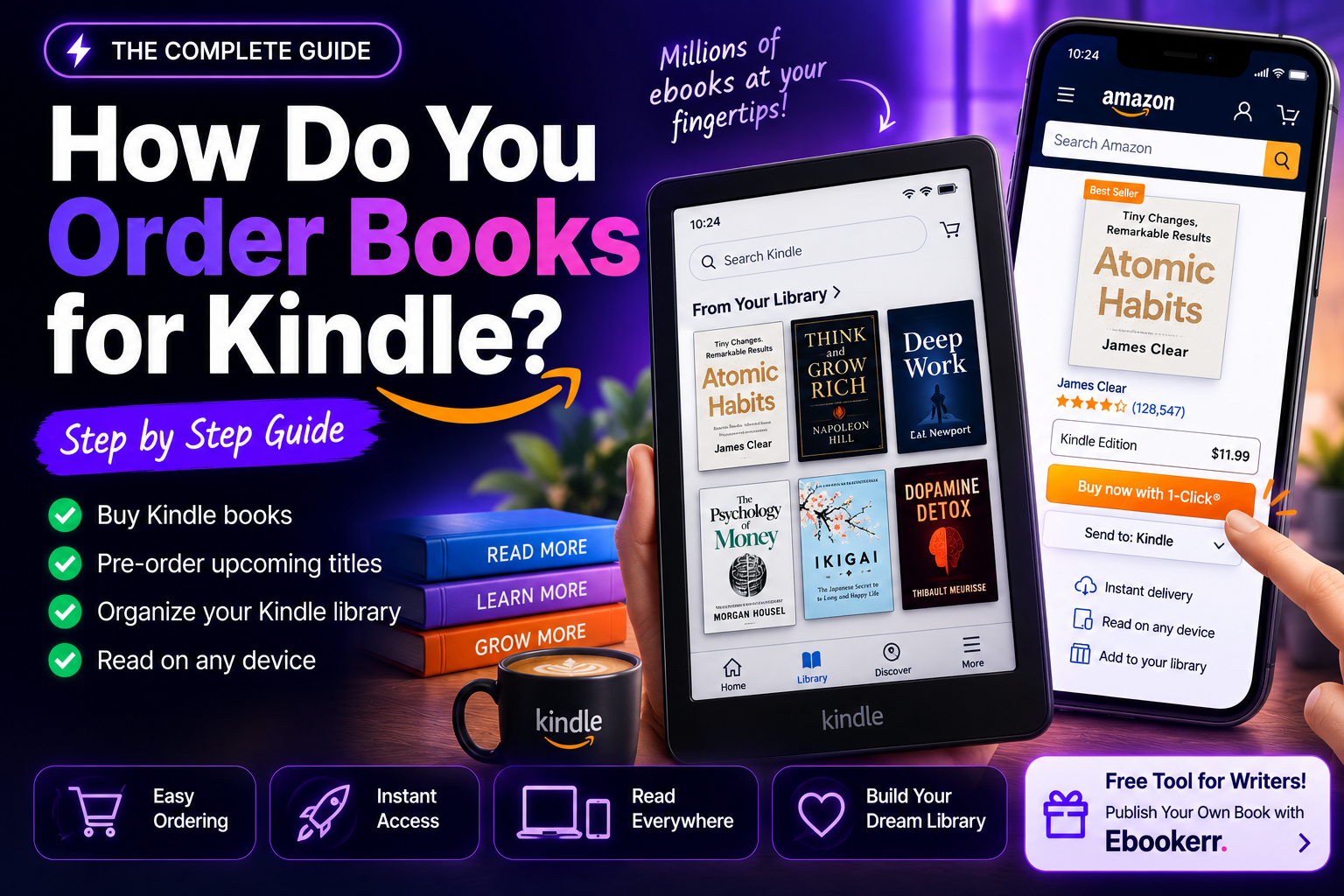
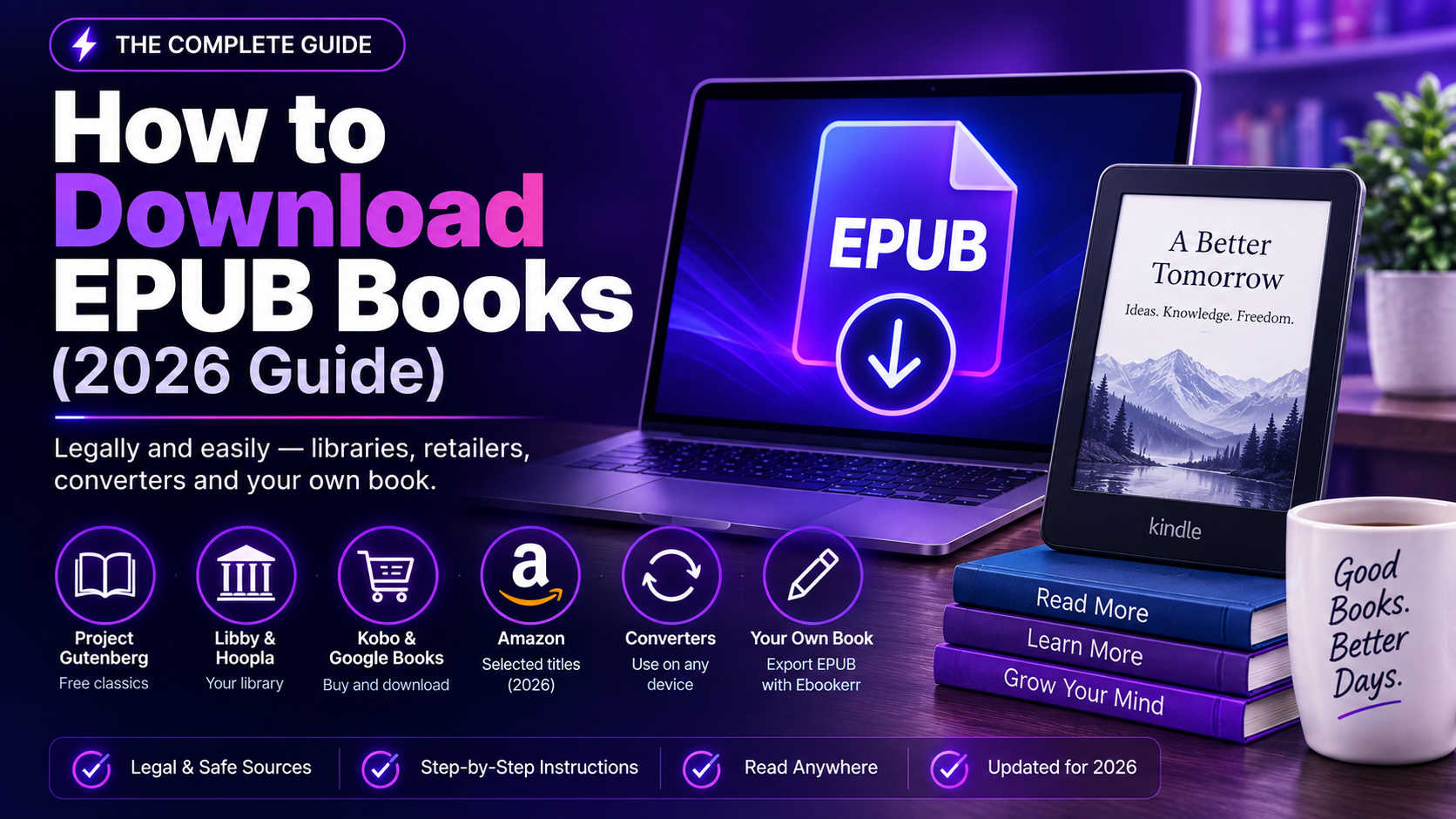
⚡ Quick answer: The fastest legal ways to get free books on ebooks are: browse the free sections on Amazon Kindle, Kobo, or Google Play Books; borrow current titles through a public library with the Libby app; download classics for free from Project Gutenberg or Standard Ebooks; and subscribe to BookBub for a daily digest of free and discounted titles. All are legal and safe — no torrent sites required. Writers looking to create their own ebook for free can do the same with Ebookerr‘s free trial (3 ebooks, no credit card).
Many avid readers spend $50 to $60 a month on Kindle books without ever auditing where that reading budget actually goes. When one longtime reader finally sat down and reviewed a year of purchases, the finding was striking: at least half of what had been bought that year was available legally, for free, if only the right places had been known. That kind of audit is the basis for this guide — a list built by testing more than a dozen platforms, library apps, and publisher promotions, and tracking what actually works versus what wastes time or, worse, hands an email address to a spam list.
Anyone wondering how to get free books on ebooks without pirating anything or downloading a virus disguised as a PDF is in the right place. This guide walks through public domain libraries, local library digital shelves, retailer promotions, deal-alert newsletters, and author giveaways — the same channels working readers and librarians actually rely on. It also flags the traps: sketchy “free download” sites that exist mainly to harvest data or install malware.
Why So Many People Search for Free Ebooks
Ebooks should, in theory, be cheaper than print. No paper, no shipping, no warehouse. But publishers often price digital editions close to hardcover rates, and a habit of two or three books a month adds up fast. At the same time, readers are living through one of the best eras in history for legitimately free reading material. Copyright terms expire, authors use free first-in-series books as marketing, and public libraries have poured money into digital lending. The result is that knowing how to get free books on ebooks isn’t a shortcut or a gray-area hack — it’s simply knowing where the legal supply actually is.
There’s also a practical, experience-based reason this matters: the “free download” search results are dominated by low-quality aggregator sites that repackage pirated files, wrap them in five pop-up ads, and sometimes bundle in malware. Enough of these sites have been tested to say confidently that the risk to a reader’s device and data isn’t worth it. The sources below are ones that hold up to real, repeated use — the kind worth recommending to a friend.
1. Start With Public Domain Libraries
The single best starting point for how to get free books on ebooks is the public domain — books whose copyright has expired, which anyone can legally read, share, and redistribute at no cost.
Project Gutenberg is the original and still the largest, with more than 70,000 titles spanning classic literature, philosophy, poetry, and reference works. Everything is available in EPUB, Kindle-compatible, and plain text formats, with no sign-up required.
Standard Ebooks takes public domain texts from sources like Gutenberg and re-produces them with modern, carefully proofread typography and formatting — the difference in reading experience is noticeable, especially on an e-ink device.
Open Library, a project of the Internet Archive, blends public domain access with a “controlled digital lending” system for newer, still-copyrighted titles, similar to how a physical library lends one copy at a time.
ManyBooks and Feedbooks curate public domain catalogs into cleaner, more browsable storefronts for readers who find Gutenberg’s plain interface hard to navigate.
The tradeoff is obvious: public domain means older. In the US, that generally means books published before 1929 (the cutoff moves forward each January). For classic literature, this is a goldmine. For last year’s bestseller, the next few methods matter more.
2. Use a Local Library’s Digital Card
This is the method most people underestimate, and it’s the one worth trying first for anyone asking how to get free books on ebooks that are actually current releases.
Libby, run by OverDrive, connects to an existing public library card and lets readers borrow ebooks and audiobooks the same way they’d borrow a physical copy — for a set loan period, after which the file simply expires. Most public library systems support it, and many let patrons sign up for a digital card online even without ever visiting a branch.
Hoopla works on a similar principle but with a different licensing model, often giving instant access without a hold queue, though monthly borrow limits set by the local library may apply.
For anyone without a library card, registering typically takes about five minutes online, and cardless digital cards are increasingly common in cities that want to reduce access barriers. That single step — registering for a library card — is probably the highest-value five minutes a frequent reader can spend.
3. Check Retailer Free Sections
Amazon, Apple Books, Kobo, and Google Play Books all maintain dedicated free ebook sections, refreshed regularly, and this is often the fastest answer to how to get free books on ebooks when the goal is something published in the last few years rather than a century-old classic.
Amazon’s Kindle Free Bestseller list rotates constantly and mixes public domain classics with limited-time promotional freebies from publishers trying to build an author’s readership — often the first book in a series, with the rest sold at full price.
Google Play Books has a persistent free-ebooks category, browsable by genre, and doesn’t require a Kindle device since it works through the app on any phone, tablet, or computer.
Kobo and Apple Books run similar promotional sections, and because Kobo integrates with library lending through OverDrive in many regions, it can double as a library-access point too.
A word of caution: some “free” listings on Amazon are only free for Kindle Unlimited subscribers, not the general public, so checking the price tag before assuming a genuine freebie is worthwhile.
4. Subscribe to Deal-Alert Services
For readers who’d rather have free and deeply discounted ebooks come to them instead of hunting for them, deal-alert newsletters are worth the inbox space.
BookBub is the best known — readers set their favorite genres, and it emails a daily digest of free and discounted ebooks matched to that taste, pulled from major retailers.
Freebooksy and ManyBooks’ newsletter operate on the same model with slightly different catalogs, and subscribing to two or three of these costs nothing but a bit of inbox clutter.
This is genuinely one of the lowest-effort answers to how to get free books on ebooks long-term: set it up once, and new opportunities show up automatically instead of requiring continued searching.
5. Go Directly to Authors
Many independent and hybrid-published authors give away ebooks directly, usually as a way to build an email list or launch a new series.
Author newsletters frequently offer a free novella, short story, or the first book in a series exclusively to subscribers — checking the author’s own website rather than a retailer is worthwhile for fans of a specific writer.
BookFunnel and StoryOrigin power many of these giveaways behind the scenes, hosting multi-author promotional bundles where dozens of writers in a genre each contribute a free title.
ARC (Advance Reader Copy) programs, run through platforms like NetGalley or directly by publishers, give free early access to upcoming books in exchange for an honest review — a fair trade for readers who enjoy writing reviews anyway.
6. A Quick Word on Safety
Because the question of how to get free books on ebooks brings up so many low-quality search results, it’s worth being explicit about red flags: sites that require a credit card “just for verification” on a supposedly free download, browser extensions bundled with an ebook download, and file formats other than EPUB, MOBI, or PDF from an unfamiliar source. Sticking to the platforms above, keeping antivirus software current, and treating any site that demands personal information before a “free” download as a scam are the safest defaults.
Bonus: For Those Writing the Book, Not Just Reading It
Everything above is aimed at readers looking for something to download and enjoy. But a fair number of people who search this topic are on the other side of the equation — they’ve got a book idea, a niche expertise, or a manuscript sitting half-finished, and money is the thing standing between them and getting it out into the world.
For that group, it’s worth knowing that creating an ebook doesn’t have to cost anything upfront either. Ebookerr is an AI-powered ebook creation platform that handles the parts most first-time authors get stuck on: drafting chapters from an outline, designing the interior with professional templates, generating a cover, and exporting a finished file in EPUB, PDF, or Word format ready for KDP or another distributor. Ebookerr’s free trial lets writers build up to three complete ebooks at no cost and without a credit card, using its Lite feature set — genuinely useful for anyone testing whether self-publishing is the right fit before paying for anything.
It’s a different kind of “free” than the reader-focused options above, but it closes the loop nicely: readers get free books through libraries, public domain archives, and author promotions, and aspiring authors can get their own book made and out the door for free through a tool like Ebookerr, then use some of the same channels above — a BookFunnel giveaway, a free first-in-series listing on Amazon — to find their first readers.
Curious what a finished book could look like? Ebookerr lets anyone start their first ebook free — no credit card, no commitment, just three ebooks on the house while deciding if it’s the right fit.
Frequently Asked Questions
What’s the fastest way to get free books on ebooks right now? For something needed today, opening the Kindle, Kobo, or Google Play Books app on whatever device is at hand and browsing its free section requires no sign-up beyond an account most readers already have. For a more sustainable answer to how to get free books on ebooks over the coming months, registering for a library card and installing Libby takes longer to set up once but pays off indefinitely.
Is it actually legal to get free ebooks? Yes, as long as the channel is legitimate. Public domain archives, library lending apps, retailer promotions, and author giveaways are all fully legal — the authors and publishers either no longer hold copyright, have explicitly chosen to distribute for free, or have licensed the copy through a library system. Torrent sites and “free PDF download” aggregators that host copyrighted material without permission are a different story, and using them can expose a device to malware on top of the legal and ethical problems.
What file format should readers look for? EPUB is the most universally supported format across apps and e-readers other than Kindle, which prefers its own AZW/KFX formats but also accepts converted files. A “free” site that only offers an .exe file or asks for a special reader to be installed is a red flag rather than a normal ebook.
Does someone need to own a Kindle or other e-reader device? No. Every major platform mentioned here — Libby, Kindle, Kobo, Google Play Books, Apple Books — has a free app that runs on phones, tablets, and computers, so reading is possible on whatever device someone already owns.
How often do free listings change? Retailer free sections and BookBub-style newsletters update daily, library holds free up as other readers return their loans, and author promotions typically run for a limited window tied to a book launch. Checking in on a rotation — say, once a week — is usually enough to keep a steady supply of new titles without spending real time hunting.
Is there a catch with free ebook creation tools like Ebookerr? The free tier is capped rather than time-limited: writers can build up to three complete ebooks with the Lite feature set and no credit card, and if that isn’t enough, the paid plans add audiobook narration, translation, and Amazon metadata optimization. There’s no hidden charge during the free portion.
Putting It Into Practice
If there’s one thing to take from this guide, it’s this: registering for a digital library card today and installing Libby is the single method most likely to deliver current, high-quality free reading for years to come. Layering in a BookBub subscription adds a steady trickle of discovered titles, and bookmarking Project Gutenberg or Standard Ebooks covers the moments when a classic sounds appealing. Between those three habits, a reader will rarely run out of things to read, and will rarely need to ask how to get free books on ebooks again — the answer will already be at hand.
And for anyone whose itch isn’t “what should I read next” but “there’s a book in me,” the free-and-legal principle works both ways. Starting small, exploring the free options, and not letting the cost of getting started be the reason a good book — someone else’s or one’s own — never gets read is advice worth taking either way.
About this guide: compiled by the Ebookerr editorial team, drawing on years of hands-on testing of library apps, retailer promotions, and independent author platforms. Sources and services mentioned reflect direct, firsthand use rather than secondhand roundups.