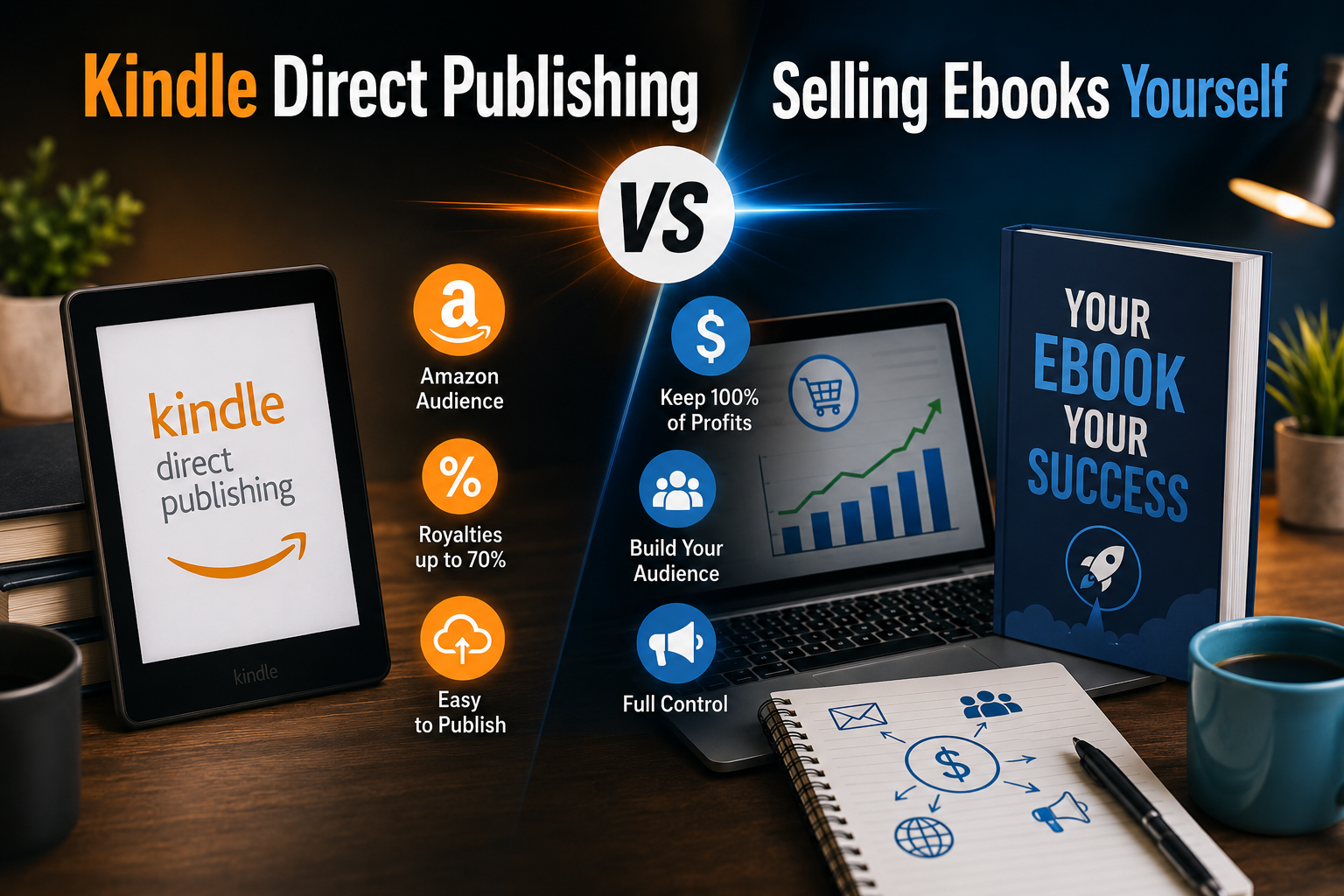
Quick answer: Kindle Direct Publishing (KDP) gives access to Amazon’s massive built-in audience and handles distribution automatically, but comes with only a 35% royalty rate outside the $2.99–9.99 price band, exclusivity restrictions under KDP Select, and less control over pricing and customer data. Selling ebooks independently — through a personal website, Gumroad, or Etsy — keeps 100% of the revenue (minus platform fees), allows full pricing freedom, and builds a direct customer relationship, but requires the seller to generate their own traffic instead of relying on Amazon’s search and recommendation engine. Neither option is universally better; the right choice depends on whether the priority is reach or margin and control. The rest of this guide breaks down exactly how each option works in practice.
How Amazon’s Self-Publishing Platform Works
KDP is Amazon’s self-publishing platform, letting anyone upload a manuscript and have it listed for sale on Amazon within about 72 hours. It remains the largest single marketplace for ebooks by volume, which is the main reason so many authors start there.
Royalty structure. Books priced between $2.99 and $9.99 earn a 70% royalty (minus a small delivery fee based on file size). Books priced outside that range — either lower or higher — drop to a 35% royalty, which creates a strong pricing incentive to stay within that band regardless of what the content might otherwise be worth.
KDP Select. Enrolling in KDP Select requires exclusivity — the book can’t be sold as an ebook anywhere else, including a personal website or other marketplaces — in exchange for access to Kindle Unlimited (where authors earn per page read rather than per sale) and promotional tools like free book days. This exclusivity requirement is the single biggest tradeoff of the KDP ecosystem.
Discoverability. Amazon’s search and recommendation algorithms can surface a book to readers who never heard of the author, which is difficult to replicate through independent selling, especially for new authors with no existing audience.
Customer data. Amazon owns the customer relationship. Authors don’t get buyer email addresses, which makes it harder to build a direct audience for future books or products.
How Selling Ebooks Independently Works
Selling independently means listing an ebook through a personal website, a platform like Gumroad, or a marketplace like Etsy, rather than routing every sale through Amazon.
Revenue share. Gumroad typically takes a small percentage plus a transaction fee (around 10% combined on standard plans), while a personal website using a payment processor like Stripe or PayPal usually keeps costs closer to 3–5% in processing fees, with no platform commission at all.
Pricing freedom. Without Amazon’s royalty band influencing the decision, sellers can price based purely on perceived value, niche norms, and what their own audience is willing to pay — a $47 in-depth guide is entirely reasonable independently, whereas the same content on Kindle would face a steep royalty penalty above $9.99.
No exclusivity requirements. A book sold independently can also be listed on Kindle, sold as a PDF on Etsy, and offered through an email list simultaneously, since there’s no platform locking the content into a single channel.
Full customer ownership. Every sale made independently comes with a direct email address (when using tools that capture this at checkout), which builds an asset the seller actually owns — useful for launching a second book, a course, or any future product to the same audience.
The traffic tradeoff. The core disadvantage is that independent selling has no built-in audience. Every sale requires driving traffic through SEO content, social media, an email list, or paid ads — work that Amazon’s platform largely handles automatically for KDP authors, at least in terms of surfacing the book to relevant searches.
Side-by-Side Comparison
| Factor | Kindle Direct Publishing | Selling Independently |
|---|---|---|
| Royalty rate | 35–70% (price-dependent) | ~90–97% after processing fees |
| Built-in audience | Yes, Amazon’s marketplace | No, requires own traffic |
| Pricing freedom | Limited by royalty bands | Full control |
| Exclusivity required | Only under KDP Select | Never |
| Customer email data | Not provided | Fully owned |
| Format flexibility | Kindle-specific formatting | PDF, EPUB, Word, or any mix |
| Setup complexity | Low — Amazon handles distribution | Moderate — requires a checkout and delivery system |
Which Option Fits Which Type of Seller
New fiction authors with no existing audience often benefit most from starting on KDP, since Amazon’s discovery tools give a new book visibility that would otherwise take significant time and money to replicate independently.
Nonfiction creators building a business around their content — coaches, consultants, niche experts — tend to do better selling independently, since the goal usually isn’t just book revenue but building an audience and email list that supports future products, which KDP doesn’t provide.
Sellers targeting a specific, high-value niche (business guides, professional templates, specialized how-to content) often see stronger returns independently, since KDP’s royalty structure penalizes pricing above $9.99, while the same content sold through a personal website or Gumroad can reasonably command $30–75.
Sellers with an existing audience — a blog, YouTube channel, or email list — have the traffic problem largely solved already, which tips the calculation strongly toward independent selling, since there’s no need to rely on Amazon’s discovery engine when an audience already exists elsewhere.
Sellers testing a brand-new topic with zero audience may find KDP’s built-in reach valuable purely for market validation, even if the long-term plan is to eventually build an independent sales channel once the concept proves it has demand.
The Hybrid Approach
Many established authors and creators don’t treat this as an either-or decision. A common strategy is to publish through KDP for the discovery benefits, while also selling a version independently — through a personal website or Gumroad — for readers who prefer to buy directly, as long as the book isn’t enrolled in KDP Select’s exclusivity requirement.
This hybrid model works especially well for nonfiction and guide-style content, since a PDF version sold independently can include bonus material, updated content, or companion resources that the Kindle version doesn’t have, giving buyers a reason to choose the direct purchase route even when the book is also available on Amazon.
Producing both versions from a single source document is far easier with a tool that exports multiple formats. Ebookerr, for example, exports the same content to EPUB, PDF, and Word from one project, which means a book can be formatted for Kindle (EPUB) and for independent PDF sale simultaneously, without maintaining two separate files or paying for two different tools. At $9.97/month for unlimited use, it also removes the cost barrier to producing companion lead magnets or bonus chapters specifically for the independent sales channel.
Common Mistakes on Both Sides
Enrolling in KDP Select without understanding the exclusivity clause. Some authors sign up for the promotional benefits without realizing it prevents selling the same book anywhere else, including their own website, for the 90-day enrollment period.
Pricing outside the 70% royalty band without a clear reason. Setting a Kindle price at $12.99 instead of $9.99 can look like more revenue per sale, but the royalty rate drop to 35% often makes it a net loss compared to staying within the band.
Underestimating the traffic requirement for independent selling. Simply listing a book on a personal website without any plan for driving traffic — SEO content, an email list, social promotion — rarely produces meaningful sales on its own.
Treating the two channels as identical. Formatting requirements, pricing norms, and reader expectations differ enough between Kindle and independent sales that copying the exact same approach across both usually underperforms compared to tailoring each channel slightly.
What Switching Costs Later
A decision made at launch isn’t necessarily permanent, but switching paths later comes with real friction worth planning for in advance.
Moving from KDP to independent selling. Leaving KDP Select is straightforward — simply don’t renew the 90-day enrollment — but a book that built its review count and sales rank primarily through Amazon’s ecosystem won’t carry that momentum over to a new independent storefront. Reviews, in particular, stay tied to the Amazon listing and don’t transfer, meaning an author moving toward independent sales after building an audience on KDP effectively starts the trust-building process over again on the new channel.
Moving from independent selling to KDP. This direction tends to be smoother, since a book with an established audience and existing sales history can be uploaded to KDP at any time without losing what’s already been built independently — as long as it isn’t then locked into KDP Select’s exclusivity terms, which would require pulling it from other channels.
Maintaining both from the start. Authors who anticipate wanting flexibility later are often better served by avoiding KDP Select exclusivity from the beginning, even if it means missing out on Kindle Unlimited page-read revenue. Standard, non-exclusive KDP publishing preserves the option to sell independently at any point without needing to unwind an exclusivity agreement first.
File compatibility across the switch. One practical advantage of using a multi-format tool from the outset is avoiding a costly reformatting project if the sales strategy changes later. A source file that already exports cleanly to EPUB, PDF, and Word — the way Ebookerr handles it — means a switch between channels is a matter of re-uploading an existing export rather than rebuilding the book’s formatting from scratch for a new platform’s requirements.
Frequently Asked Questions
Can I sell my ebook on both Kindle and my own website at the same time? Yes, as long as the book isn’t enrolled in KDP Select, which requires exclusivity to Amazon. Standard KDP publishing (outside of Select) allows selling the same content anywhere else simultaneously.
Which option makes more money for a new author? It depends heavily on niche and existing audience. Fiction and general-interest nonfiction with no existing following often perform better on KDP initially, due to Amazon’s discovery advantage. Niche, higher-priced guides with an existing audience typically earn more independently, due to the royalty structure and pricing freedom.
Do I need different files for Kindle versus independent selling? Formatting requirements differ slightly, but a tool that exports to multiple formats from one source — such as Ebookerr, which supports EPUB, PDF, and Word — makes it straightforward to produce both versions without duplicating the writing and design work.
Is KDP Select worth the exclusivity tradeoff? For books likely to perform well in Kindle Unlimited’s page-read model, or for authors specifically trying to build reviews and rank quickly on Amazon, the tradeoff can be worth it temporarily. For creators planning to build an independent audience or sell through multiple channels, the exclusivity requirement is usually a bigger cost than the promotional benefits justify.
What’s the biggest risk of selling independently? The main risk isn’t financial — it’s the traffic problem. Without Amazon’s built-in search and recommendation system, an independently sold ebook needs its own source of consistent visitors, whether through SEO content, an email list, or paid promotion, or it simply won’t generate meaningful sales regardless of how good the book is.
Final Thoughts
KDP and independent selling solve different problems. KDP trades margin and control for built-in discoverability, which makes it a strong starting point for authors with no existing audience. Independent selling trades that discovery advantage for full pricing freedom, direct customer ownership, and significantly higher margins, which tends to favor creators who already have some audience or are building a broader business around their content rather than a single book. For many creators, the most practical path is a hybrid one — publishing through KDP for reach while also selling directly for margin — made easier by using a tool like Ebookerr that produces both formats from the same source content without extra cost or effort.