Introduction
Writing a full-length ebook used to mean weeks, sometimes months, of staring at a blank page, wrestling with structure, and slowly grinding through chapter after chapter. That timeline has changed. Today, a growing number of independent authors, coaches, and small business owners are learning how to write an ebook with AI — and cutting their production time down from months to days, without turning out generic, robotic-sounding content in the process.
This shift isn’t about letting a machine do all the thinking. The writers who get the best results treat AI as a drafting partner, not a replacement for their own expertise. What follows is a practical, honest look at how the process actually works, based on how creators are using tools like ebookerr.com today to move from a rough idea to a finished, publishable manuscript.
Why Writing an Ebook with AI Actually Works
The traditional bottleneck in ebook creation was never the idea — it was the execution. Most people who want to write a book already have something worth saying: a skill they’ve mastered, a problem they’ve solved, a perspective shaped by real experience. What stopped them was the sheer time cost of translating that knowledge into 20,000, 40,000, or 60,000 well-organized words.
AI removes that specific bottleneck. It doesn’t remove the need for expertise, and it doesn’t remove the need for editing — but it collapses the time between “I have an idea for a book” and “I have a full first draft” from months down to a matter of days or even hours for shorter guides. This is precisely why learning how to write an ebook with AI has become one of the most talked-about shifts in independent publishing over the past two years.
There’s also a quality argument that often gets overlooked. A rushed, manually-written first draft is frequently thin, repetitive, and inconsistent in tone because the author is exhausted by chapter twelve. A well-directed AI draft, reviewed carefully by someone who knows the subject, can actually be more consistent in structure and pacing than a manuscript written entirely by hand over three exhausting months.
Step 1: Start With a Real Outline, Not a Vague Idea
Every successful AI-assisted ebook begins the same way every successful traditionally-written ebook begins: with a clear outline. This step matters more with AI, not less, because the quality of an AI-generated draft is directly tied to the quality of direction it’s given.
A strong outline for someone learning how to write an ebook with AI typically includes:
- A working title and a one-sentence description of who the book is for
- A list of chapters, each covering one clear idea
- Two to four bullet points under each chapter showing what it needs to cover
- A rough sense of total length (a short guide might run 15–25 pages, a comprehensive one 50–70+)
Skipping this step is the single most common reason AI-assisted drafts feel scattered or shallow. Without a structure to follow, even the most capable writing assistant will produce content that wanders, repeats itself across chapters, or misses the specific angle that makes a book worth reading in the first place.
Step 2: Give Specific, Detailed Direction — Not Generic Prompts
There’s a wide gap between typing “write a chapter about email marketing” and giving a writing assistant a clear brief: the target reader, the tone, the specific points that must be covered, and any personal experience or examples to weave in. The second approach is what separates a genuinely useful draft from generic, forgettable filler text.
Writers who consistently produce strong results tend to work chapter by chapter rather than asking for an entire book at once. This keeps the tone consistent, makes it easy to redirect early if something isn’t landing right, and mirrors how ebookerr.com’s own chapter-and-part editor is designed to work — building the manuscript one structured section at a time rather than generating an entire book in one uncontrolled pass.
A useful habit at this stage is treating the AI the way a writer might brief a genuinely talented ghostwriter: specific facts to include, a target word count for the section, the reading level, and — critically — space to add something only the author would know. That last point turns out to be the difference between a forgettable ebook and one people actually recommend.
Step 3: Add the Human Layer AI Can’t Fabricate
This is the step most often skipped, and it’s the one that matters most for both readers and search engines. No AI system can generate genuine firsthand experience. It can produce plausible-sounding advice, but it cannot know what actually happened when a specific author tried a specific approach, what mistake they made, or what result they personally achieved.
Google’s E-E-A-T framework — Experience, Expertise, Authoritativeness, and Trustworthiness — has become increasingly central to how content, including ebooks promoted through blog content and landing pages, gets evaluated and ranked. A chapter that reads as pure, generic advice performs differently than one where the author includes a real example: a specific number, a mistake they corrected, an opinion shaped by actually doing the thing being described.
This is where an author’s judgment becomes irreplaceable in the process of learning how to write an ebook with AI. The AI can produce the scaffolding — clear explanations, logical structure, readable prose — but the details that build genuine trust with a reader have to come from the person who lived them.
Practical ways to layer this in include:
- Replacing a generic example with a specific, real one from the author’s own experience
- Adding a short “what I’d do differently” note at the end of relevant chapters
- Including real numbers where possible, rather than vague claims like “significant results”
- Noting explicitly when information could change over time, and when it was last verified
Step 4: Edit for Voice, Not Just Errors
A common mistake among first-time AI-assisted authors is treating the editing pass as a simple proofread — checking for typos and moving on. That misses the more important editing job: making sure the manuscript sounds like one consistent person wrote it.
AI-generated drafts, especially when produced across many separate sessions, can drift slightly in tone from chapter to chapter. A careful read-through — ideally after stepping away from the material for at least a day — usually reveals a handful of places where phrasing feels slightly off, a term is used inconsistently, or a section reads more formally than the surrounding chapters.
This editing pass is also the natural point to tighten anything that reads as padded or repetitive. AI tools are capable of genuinely concise writing when directed well, but they can also default to restating a point in slightly different words if the original direction wasn’t specific enough. A confident editor trims this without hesitation — shorter, sharper chapters consistently outperform longer, softer ones in reader satisfaction.
Step 5: Format, Export, and Prepare for Publishing
Once the content itself is solid, formatting becomes the final technical hurdle — and it’s exactly the kind of task that used to require either design skills or outsourcing. A properly formatted ebook needs a clear heading hierarchy, consistent spacing, a working structure for chapters and parts, and clean export into whatever file format the target platform requires.
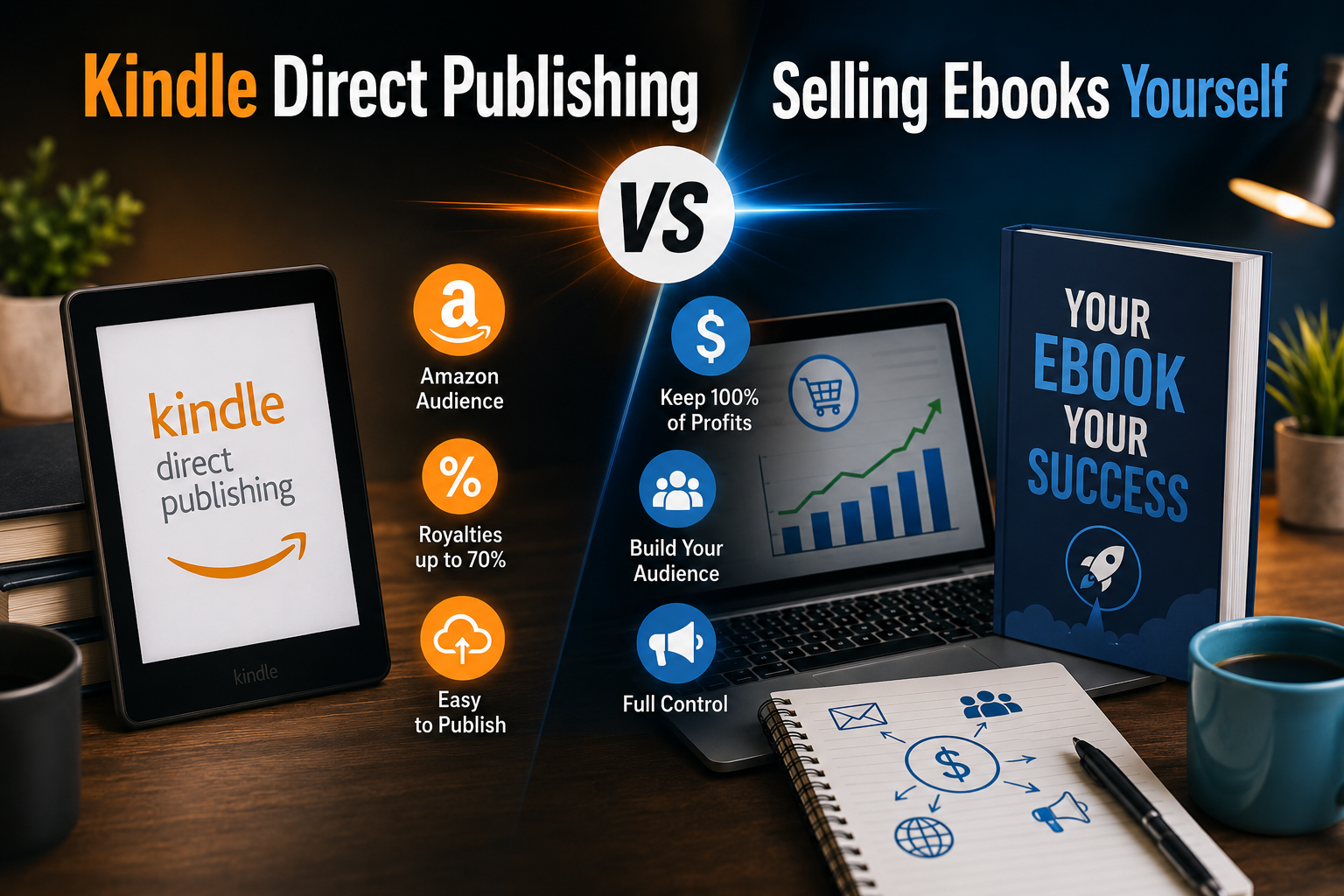
This is where a dedicated ebook creation tool changes the workflow meaningfully. Rather than manually wrestling with a word processor’s formatting quirks, a platform like ebookerr.com is built specifically around this stage of the process: organizing content into chapters and parts, generating a cover, and exporting cleanly to EPUB, Word, or PDF depending on where the book is headed — Amazon KDP, a direct sales page, or a lead magnet on a website.
Different destinations call for different formats. EPUB remains the standard for most retailers, including Amazon KDP and Apple Books, because it reflows text to fit any screen. PDF preserves an exact, fixed layout, which suits workbooks or visually structured guides better. Getting this step right the first time avoids the frustrating cycle of re-exporting and re-uploading after a retailer flags a formatting issue.
Working Across a Longer Manuscript
Short guides and full-length books present different challenges when working with AI, and it’s worth understanding the difference before committing to a length. A 15-page guide can often be drafted in a single extended session, since the writer can hold the entire structure in their head and keep tone consistent almost automatically. A 60-page or 100-page manuscript is a different kind of project, and it rewards a more deliberate process.
The main risk on longer projects is drift — small shifts in tone, terminology, or level of detail that accumulate unnoticed across dozens of sections. A phrase that felt natural in chapter three can feel out of place by chapter twenty if the direction given to the AI wasn’t consistent throughout. Experienced authors manage this by keeping a short reference note nearby: the target reader, the tone (casual, professional, technical), and a handful of terms that should be used consistently rather than varied for the sake of variety.
Working in parts rather than treating the whole manuscript as one undifferentiated block also helps considerably. Grouping related chapters into named sections — the way ebookerr.com’s own part-and-chapter structure encourages — gives both the author and the AI a clearer sense of where each piece fits in the larger arc. It also makes it far easier to reorganize later, since moving a part is simpler than untangling content buried inside one continuous file.
Another practical habit worth adopting: read the manuscript in full at least once before the final export, not just chapter by chapter as it’s produced. Individual sections can each read well in isolation while still adding up to a book that repeats the same point three separate times, or that never quite delivers on something promised in the introduction. This full read-through is usually where an author catches the handful of structural issues that chapter-level editing alone tends to miss.
Choosing Between a Fully Solo Draft and AI Assistance
Some writers still ask whether it’s worth learning how to write an ebook with AI at all, versus simply writing the entire thing by hand the traditional way. The honest answer depends less on ideology and more on what the writer is optimizing for.
A fully manual draft can carry a particular kind of voice that comes from unbroken, uninterrupted composition — some authors genuinely prefer that process, and for fiction or highly personal memoir-style writing, it often remains the stronger choice. But for the kind of practical, instructional, or informational ebooks that make up the majority of the independent publishing market — guides, how-tos, niche expertise turned into a product — the calculus shifts. Readers of this kind of book are looking for clarity, usefulness, and organized information, not literary voice for its own sake. That’s precisely the kind of writing where AI assistance tends to produce the strongest results relative to the time invested.
A middle path many writers land on is hybrid: drafting the introduction and a couple of chapters manually to establish a clear personal voice, then using that voice as a reference point when directing AI for the remaining chapters. This keeps the most personal, opinion-heavy sections entirely in the author’s own words while still capturing the time savings on the more structural, explanatory content that makes up the bulk of most non-fiction ebooks.
Common Mistakes to Avoid
A handful of patterns show up repeatedly among writers still learning how to write an ebook with AI effectively:
Skipping the outline entirely. Jumping straight into chapter generation without a structure almost always produces a book that feels disjointed by the halfway point.
Accepting the first draft without a real edit. Even a strong first draft benefits from a deliberate pass focused on voice, accuracy, and trimming anything repetitive.
Leaving out personal experience. Books that read as entirely generic — however well-organized — struggle to build the trust that turns a reader into a recommender.
Publishing without fact-checking. Prices, statistics, tool names, and specific claims should always be verified before publishing, since accuracy directly affects reader trust and, over time, search visibility.
Underestimating formatting. A well-written manuscript that arrives at a retailer poorly formatted creates unnecessary friction and can delay or complicate the publishing process.
The Realistic Expectation
Learning how to write an ebook with AI doesn’t mean skipping the thinking — it means redirecting where the effort goes. Instead of spending most of a project’s time on the mechanical act of typing out thousands of words, an author spends that time on direction, judgment, and the personal details that no AI system can invent. The actual writing speeds up dramatically; the parts that separate a good ebook from a forgettable one — genuine expertise, real experience, careful editing — still require a human hand.
For anyone ready to move from outline to a fully formatted, exportable manuscript, tools built specifically for this workflow remove most of the remaining friction. Platforms like ebookerr.com combine an AI writing assistant with a structured chapter-and-part editor and direct export to EPUB, Word, and PDF, so the transition from finished draft to published ebook doesn’t require learning a separate set of design or formatting skills.
The barrier to publishing a genuinely useful ebook has never been lower. The gap between the people who finish and the people who don’t isn’t talent or access to AI — both of those are now widely available. It’s whether the author brings their own real experience into the process, edits with intention, and follows through from first outline to final export.
Frequently Asked Questions
Is it still possible to write an ebook with AI and have it sound authentic?
Yes, provided the author treats the draft as a starting point rather than a finished product. The most authentic-sounding AI-assisted ebooks are the ones where a real person has added specific details, corrected anything generic, and rewritten passages that don’t match their natural voice.
How long does it take to write an ebook with AI compared to writing one manually?
A short, focused guide can go from outline to finished draft in a matter of days when working chapter by chapter with clear direction, compared to the weeks or months a fully manual draft often takes. The editing and formatting stages still require real time, but the drafting bottleneck shrinks dramatically.
Does using AI to write an ebook hurt its chances with Google or Amazon?
Neither platform penalizes content simply for being AI-assisted. What both reward, and what both can penalize the absence of, is genuine usefulness, accuracy, and evidence of real expertise — the same standards that applied to manually written content long before AI tools existed.
Anyone approaching their first project with this process should expect the same outcome experienced authors describe: learning how to write an ebook with AI changes where the effort goes, not whether effort is still required.