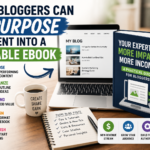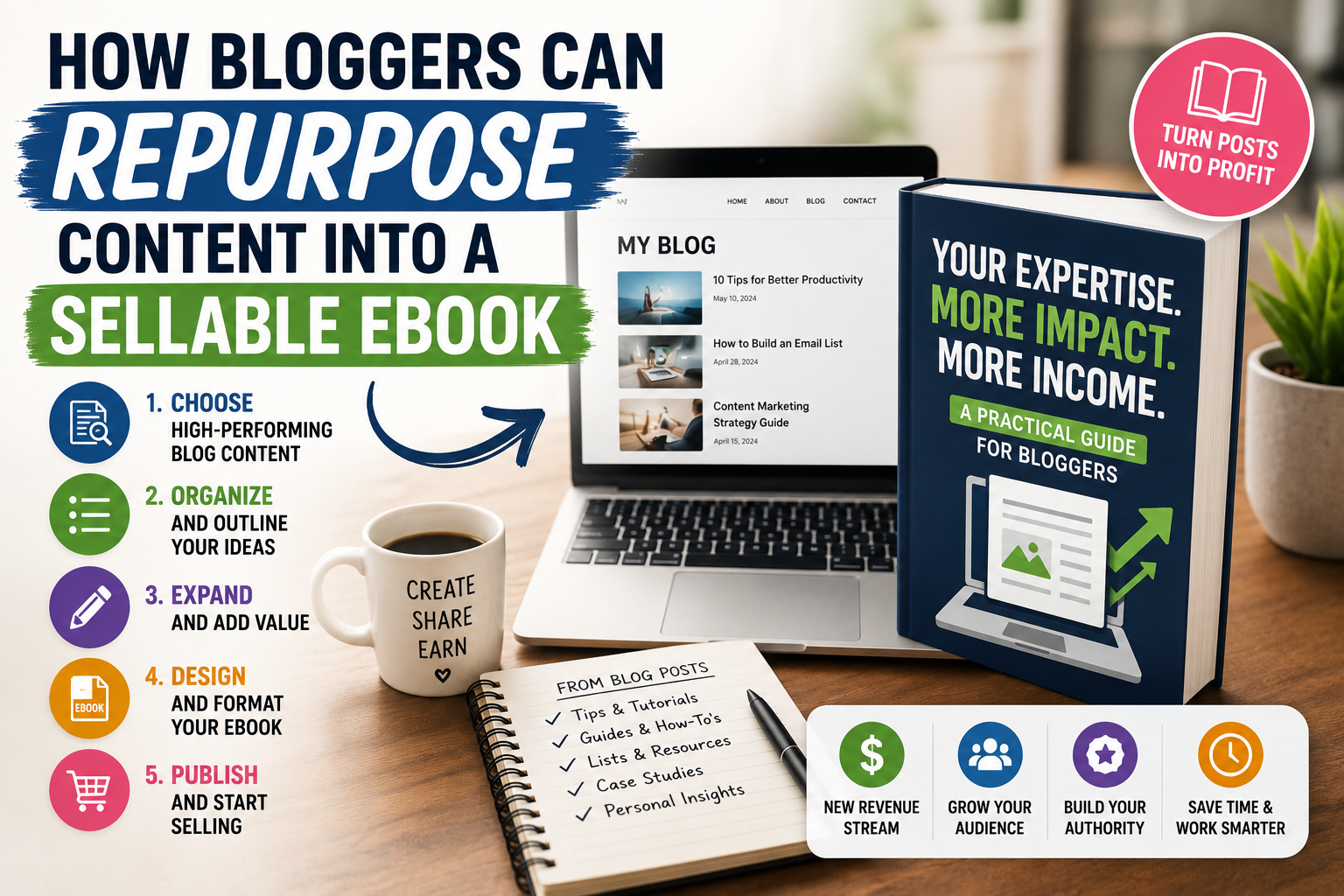
Quick answer: Yes, bloggers can turn existing posts into a sellable ebook by grouping related articles around one clear outcome, removing repetition, updating outdated information, and adding structure a blog format can’t offer — a table of contents, consistent formatting, and a logical beginning-to-end flow. Most successful repurposed ebooks come from 8–15 related posts on a single topic, rewritten into a cohesive whole rather than simply pasted together, then packaged as a PDF and sold through a marketplace or your own site. The content research is already done; the real work is in organizing and polishing it into something a reader would pay for.
If that’s the piece you needed, you already have most of what it takes to get started — a blog with existing posts. The rest of this guide covers exactly how to choose which posts to use, how to reorganize scattered articles into something that reads as one coherent book, and how to avoid the most common mistake bloggers make when trying to repurpose content into an ebook.
Why Your Blog Content Is Already Halfway to an Ebook
If you’ve been blogging consistently, you likely already have the hardest part of writing a book done: the research, the examples, and a body of proven, tested content. Blog posts that have generated comments, shares, or steady search traffic have already been validated by real readers — which is more market research than most people writing a book from scratch ever get. Repurposing that content into an ebook isn’t cutting corners; it’s recognizing that you’ve already built the raw material, and now need to shape it into a different format.
The mistake to avoid from the outset is treating this as a copy-paste job. A blog is read in short, disconnected sessions, often arriving from a single search query with zero context about your other posts. An ebook is read start to finish, by someone who paid for it and expects a complete, connected experience. Repurposing well means honoring that difference, not ignoring it.
Step 1: Choose a Focused Theme, Not Your Entire Archive
The most common mistake bloggers make is trying to include everything they’ve ever written. A sellable ebook needs one clear, specific outcome — not a general tour of your blog’s greatest hits. Look through your analytics for a cluster of posts that already share a common theme and clearly build toward one useful result for a specific reader.
For example, if you blog about home businesses, a scattered mix of “how to start a business,” “productivity tips,” and “social media basics” doesn’t cohere into one ebook. But a focused theme — “everything a new local service business needs to launch its first website and get its first ten customers” — pulls together several specific, related posts into something a reader would recognize as a single, complete guide.
Step 2: Audit and Select the Right Posts
Once you have a theme, go through your archive and pull every post that genuinely fits it — not just the most popular ones, but anything that contributes a necessary piece of the full picture. A practical audit checklist:
- Does this post directly support the ebook’s core outcome, or is it only loosely related?
- Is the information still accurate, or has it changed since you published it?
- Does it overlap heavily with another post on your list, and if so, which version is stronger?
- Is there a clear gap in the sequence — a step a reader would need that no existing post currently covers?
That last point matters more than bloggers often expect. Repurposed ebooks frequently need one or two entirely new sections written to fill gaps between existing posts, since a blog written over months or years rarely covers a topic in a perfectly complete, sequential order.
Step 3: Reorganize Around a Logical Reading Order
Blog posts are typically organized by publish date, not by the order a reader actually needs the information. The first real repurposing task is reordering everything into a logical sequence — foundational concepts first, more advanced or optional material later, with each section building on the one before it rather than standing alone.
This is also where a table of contents becomes genuinely useful, not just decorative. A well-structured table of contents signals to a potential buyer, at a glance, that this is a complete, organized resource rather than a loosely bundled collection of old posts — which directly affects whether someone is willing to pay for it.
Step 4: Remove Repetition and Blog-Specific Filler
Blogs naturally repeat context across posts, since each one needs to stand alone for a reader arriving from a random search. An ebook read cover to cover doesn’t need that repetition — restating your background, re-explaining a concept you already covered two chapters earlier, or re-introducing your credentials in every section reads as padding once everything is combined into one document.
Also strip out anything written specifically for the blog format that doesn’t belong in a book: “as I mentioned in last week’s post,” date-specific references, calls to “leave a comment below,” or SEO-driven phrasing repeated for search engines rather than for a reader’s benefit. What’s left should read like it was written as a book from the start, not like a collection of posts stitched together.
Step 5: Update Anything Time-Sensitive
Older posts often reference outdated tools, pricing, statistics, or platform features. Before combining anything into a paid product, go through each section specifically checking for information that’s no longer accurate — a paid reader judges your credibility far more harshly on outdated information than a casual blog visitor would, since they’ve made a direct financial commitment expecting current, reliable guidance.
Step 6: Add Structure a Blog Format Can’t Offer
This is where a repurposed ebook earns its price beyond simply being “free content plus a cover.” Add the things a blog structurally can’t provide:
- A clear introduction framing the full scope of what the reader will get, something no single blog post needs to do on its own
- Consistent formatting — matching heading styles, consistent terminology, and a unified voice across sections originally written at different times
- Summaries or key takeaways at the end of each major section, helping a reader retain and act on the material
- Worksheets, checklists, or templates that didn’t exist on the blog at all, giving buyers something tangible beyond what they could find by reading your posts for free
Step 7: Format and Package It Properly
Once the content itself is reorganized, updated, and polished, the final step is turning it into an actual sellable file — typically a clean, professionally formatted PDF, with a proper cover, consistent typography, and a working table of contents with clickable links if the format supports it. This is the step where a tool like Ebookerr is specifically useful, since it’s built to take existing written content and quickly turn it into a polished, ready-to-sell ebook without needing separate design software or manual formatting work.
A Quick Example Walkthrough
Imagine a blogger who’s written about freelance writing for two years, covering pitching clients, setting rates, managing contracts, and dealing with difficult clients. Individually, these are solid, useful posts. Repurposed into an ebook titled something like “The Freelance Writer’s First-Year Survival Guide,” reordered into a logical sequence (getting started → pitching → pricing → managing the relationship → handling problems), stripped of repeated introductions, updated with current-year rate benchmarks, and packaged with a simple rate calculator worksheet — that same material becomes a coherent, sellable product a new freelancer would genuinely pay for, even though every underlying idea already existed for free on the blog.
Where to Sell Your Repurposed Ebook
Once packaged, the same options covered in other guides on this site apply here too — your own site if you have one, or marketplaces like Etsy and Gumroad if you don’t. Since your existing blog readers are already a warm audience familiar with your writing, an email announcement to your existing subscriber list, or a simple blog post announcing the new ebook, often converts noticeably better than any cold marketplace traffic would, since these readers have already demonstrated trust in your content by following your blog in the first place.
Common Mistakes to Avoid When Repurposing Blog Content
Pasting posts in without any real editing. The single most common failure mode is combining posts into one document with minimal changes beyond adding a cover page. Readers can tell the difference between a genuinely reorganized book and a lightly formatted archive dump, and reviews tend to reflect that difference directly.
Choosing a theme too broad to feel coherent. “Everything I’ve ever written about marketing” isn’t a book — it’s an archive. The narrower and more specific the promised outcome, the easier it is to judge which posts belong and which don’t, and the more convincing the finished result feels to a buyer.
Skipping the gap-filling step. Because blog posts are written independently over time, there are almost always small logical gaps between them once reordered into a sequence. Skipping new content to fill those gaps leaves a book that reads like a patchwork rather than a guide someone carefully built from start to finish.
Underestimating how much updating is needed. A post written two or three years ago may reference pricing, tools, or platform features that have since changed. Reviewing every section for outdated specifics is tedious but directly affects how credible the finished ebook feels to someone paying for current, reliable information.
Deciding Whether a Topic Is Ready to Become an Ebook
Not every blog theme is ready to be turned into a paid product yet. Before starting the repurposing process, it helps to check for a few signals that the topic has real earning potential:
- Consistent traffic or engagement on the relevant posts over time, rather than a single viral spike that never repeated
- Reader questions or comments asking for more detail, a downloadable version, or “is there a course/guide for this?” — a direct signal of latent demand
- A genuinely complete arc, meaning the posts you have (plus reasonable additions) can actually carry a reader from start to a real, useful outcome, rather than trailing off partway through
If these signals aren’t present yet, it may be worth writing a few more posts to round out the topic before packaging it, rather than repurposing prematurely into a thin, incomplete ebook.
Frequently Asked Questions
How many blog posts do I need to make a sellable ebook? There’s no fixed number, but 8–15 closely related posts is a common practical range — enough to feel substantial once organized, without so much material that the theme becomes too broad to feel focused.
Is it okay to sell something that was previously free on my blog? Yes, as long as the ebook version offers meaningfully more than what’s freely available — better organization, updated information, added worksheets or templates, and a complete, cohesive reading experience a scattered blog archive doesn’t provide.
Should I remove the original blog posts once I’ve turned them into an ebook? Not necessarily. Many bloggers keep the original posts live for ongoing search traffic and lead generation, while the ebook offers a more organized, updated, and convenient version for readers willing to pay for that convenience.
How long does repurposing blog content into an ebook usually take? This varies by how many posts you’re combining and how much updating is needed, but a focused 8–12 post ebook can often be reorganized, updated, and formatted within a few days to a couple of weeks of dedicated work, since the core writing is already done.