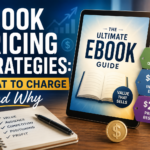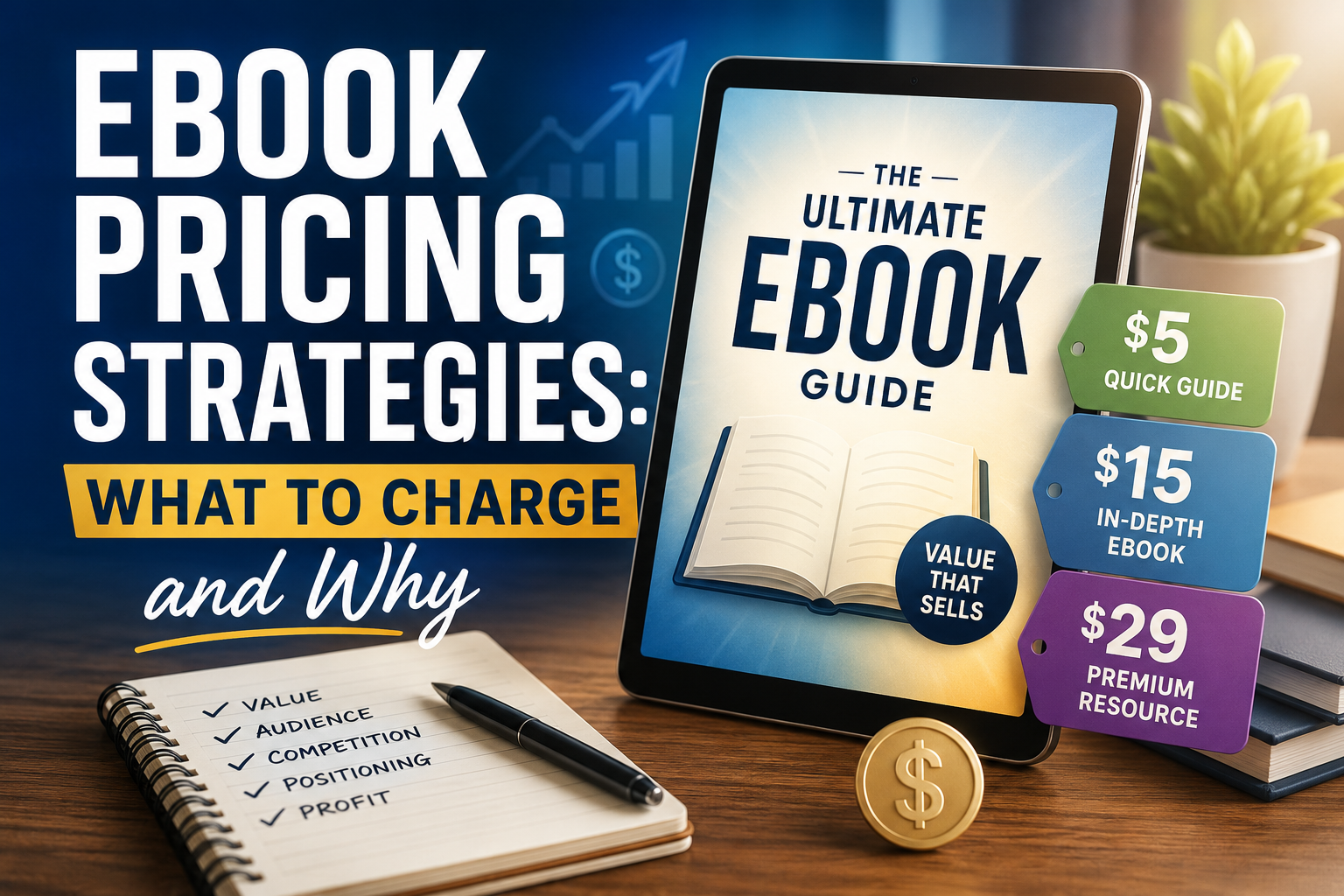
Quick answer: Most independent ebooks sell best between $2.99 and $9.99 for short guides and fiction, $15–$40 for in-depth nonfiction or workbooks, and $50+ for specialized business or professional content. The right price depends less on page count and more on the specific outcome your ebook delivers, how much competing information is freely available elsewhere, and how narrow your audience is. Underpricing is a far more common mistake than overpricing — a $4.99 ebook that took months to write rarely earns back the time invested, while a well-positioned $27 guide sold to the right niche can outperform it many times over.
If you’re staring at a blank pricing field right now, that quick answer is enough to get you moving. But pricing an ebook well is really a series of smaller decisions, and understanding the reasoning behind them will save you from second-guessing every launch. Let’s walk through the ebook pricing strategies that actually hold up in practice.
Why Ebook Pricing Feels So Confusing
Unlike a physical product, an ebook has no printing cost, no shipping fee, and no shelf space to justify. This is exactly why pricing feels harder rather than easier — there’s no obvious cost-plus formula to fall back on. A $200 hardcover textbook has a manufacturing cost baked into its price. Your ebook doesn’t, so the price has to be justified entirely by the value the reader believes they’re getting.
This is the first mental shift worth making: you’re not pricing pages, you’re pricing an outcome. A 40-page guide that saves someone 20 hours of trial and error is worth more than a 300-page book that’s mostly padding. Keep that idea in the back of your mind as we go through the rest of this guide, because it explains almost every pricing decision below.
The Three Main Factors Behind Effective Ebook Pricing Strategies
1. The specificity of the outcome
Vague, broad topics (“how to be productive”) compete against thousands of free blog posts and YouTube videos, which pushes the acceptable price down. Specific, narrow outcomes (“a 30-day system for freelance illustrators to land their first three retainer clients”) face far less free competition, and readers who match that exact description are willing to pay considerably more, because the alternative isn’t free content — it’s hours of piecing together scattered advice themselves.
2. Who’s buying it
A hobbyist buying a recipe ebook and a small business owner buying a marketing playbook have very different budgets and very different reasons for buying. Business, professional, and skill-monetization ebooks routinely sell for $20–$100+, because the buyer is mentally comparing the price against money or time they expect to gain back — not against the price of a paperback novel.
3. How much free alternative content exists
If your topic is thoroughly covered by free YouTube tutorials and blog posts, your ebook needs to either be priced low (since you’re competing with “free”), or it needs to package that scattered information into something meaningfully faster and more convenient than hunting it down yourself — which is often enough to justify a mid-range price even on a well-covered topic.
Pricing by Category: Realistic Ranges
These aren’t rigid rules, but they reflect what actually tends to sell across most niches.
- Short fiction / novellas: $0.99–$4.99
- Full-length fiction: $2.99–$6.99
- Simple guides, printables, checklists: $3–$9
- Standard nonfiction guides (30–80 pages): $9.99–$19.99
- In-depth guides, workbooks, or courses-in-book-form: $19.99–$49.99
- Niche professional or business content: $30–$150+
- Highly specialized industry reports or templates: $50–$300+
Notice the pattern: price climbs with specificity and professional relevance, not with word count. A 25-page template pack for freelance contract writers can reasonably outsell a 200-page general self-help book, because it solves an expensive, specific problem instantly.
Common Ebook Pricing Mistakes
Pricing based on effort instead of value. It’s tempting to think “this took me three months, so it should cost more than a $5 ebook.” The reader has no idea how long it took you, and doesn’t particularly care — they’re evaluating what the finished product does for them, not how it was made.
Undercutting yourself out of nervousness. Many first-time ebook sellers price at $2.99 because it “feels safer.” In practice, a low price often signals low value rather than approachability, and can actually reduce trust and perceived quality more than a moderate price would.
Ignoring the platform’s psychology. Etsy shoppers browsing digital downloads expect different price bands than someone landing on a dedicated sales page from an email newsletter. Selling the same ebook across multiple channels sometimes calls for adjusting the price, or at least the framing, to match buyer expectations on that specific platform.
Never testing a higher price. Many sellers set a price once and never revisit it. A/B testing (or simply raising the price for a month and watching conversion rates) often reveals that demand is far less price-sensitive than assumed, especially for specific, well-targeted content.
Bundling and Tiered Pricing
Instead of picking a single price, many successful ebook sellers offer tiers:
- Basic tier: the ebook alone, at a lower entry price
- Standard tier: ebook plus a workbook, checklist, or template pack
- Premium tier: everything above plus a short video walkthrough, a resource library, or email support
This approach captures both price-sensitive buyers and buyers who want the fuller package, without forcing everyone into one price point. It’s a strategy borrowed from software and course pricing, and it translates surprisingly well to ebooks, especially nonfiction and skill-based topics.
Psychological Pricing Details Worth Knowing
Numbers ending in .99 or .97 do measurably increase conversion rates compared to round numbers, particularly at lower price points ($9.99 vs. $10). At higher price points ($49 vs. $49.99), the effect becomes smaller, and some sellers of premium content deliberately use round numbers instead, since a round price can read as more confident and less “discount-store” in tone.
Anchoring also matters: showing a “regular price” struck through next to a lower “launch price” increases perceived value even when the discount is modest, because the reader now evaluates the price relative to the anchor rather than in isolation.
How to Actually Decide Your Ebook Price
A practical process, rather than guesswork:
- Identify three to five comparable ebooks in your niche, ideally ones with visible reviews or sales indicators, and note their price range.
- Position yourself within that range based on depth and specificity — if your content is more actionable or narrower in focus than the average competitor, price toward the top of the range; if it’s more introductory, price toward the bottom.
- Calculate a rough value comparison — if your ebook saves a reader real money or real hours, express that mentally as a multiple (a $20 guide that saves someone a $200 mistake is priced conservatively, not aggressively).
- Start slightly higher than feels comfortable. It’s far easier to run a discount or lower a price later than to raise it without irritating early buyers who paid full price.
- Revisit the price after your first real sales data comes in, rather than treating your launch price as permanent.
When to Lower Your Price (and When Not To)
Lowering price makes sense when: you’re running a genuine, time-limited promotion; you’re using a low-priced “front-end” ebook to build an email list and sell higher-priced products afterward; or your actual sales data clearly shows conversions dropping off sharply above a certain price point.
Lowering price is usually the wrong move when: sales are slow because of weak positioning, a poor sales page, or the wrong audience — none of which a lower price actually fixes, since the underlying problem isn’t cost, it’s relevance or trust.
A Quick Note on Pricing Across Multiple Platforms
If you’re selling the same ebook on your own site, Etsy, and perhaps Gumroad or Amazon KDP, keep pricing broadly consistent. Buyers do compare prices across platforms, and a noticeably cheaper price elsewhere can undercut trust in your primary channel. Minor platform-specific adjustments (accounting for marketplace fees, for instance) are normal, but large discrepancies are worth avoiding.
A Few Real-World Pricing Scenarios
Sometimes abstract guidelines click faster with a concrete comparison. Here are three common situations and how the reasoning above plays out in practice.
Scenario 1: A 25-page recipe ebook for busy parents. This competes directly against thousands of free recipe blogs, so pricing above $7–$9 is hard to justify unless the ebook offers something genuinely convenient — a full week’s meal plan with a matching shopping list, for instance. Here, convenience and organization are the value, not the recipes themselves, since recipes alone are freely available everywhere.
Scenario 2: A 60-page guide teaching freelance writers how to pitch literary agents. This audience is narrower, more motivated, and the outcome (landing an agent) has real financial upside. A $19–$29 price point is realistic here, since the buyer is comparing this cost against months of guesswork or an expensive writing coach, not against a free blog post.
Scenario 3: A 15-page template pack for small business owners to write their own contracts. Despite being short, this solves an expensive problem — a lawyer-drafted contract can cost hundreds of dollars. A price of $39–$79 is reasonable and often undercharges relative to the alternative, illustrating again why page count is the wrong variable to price against.
Notice that none of these examples price ebook based on length. The recipe ebook is priced low despite being fairly long relative to its category, and the contract template pack is priced high despite being short. The deciding factor in every case is the value of the specific outcome to the specific buyer, exactly as outlined earlier in this guide.
Adjusting Price as Your Ebook Matures
Pricing isn’t something you set once at launch and forget. As your ebook accumulates reviews, testimonials, or a track record of results, its perceived risk to a new buyer drops — which often supports a gradual price increase over time. Conversely, if a topic becomes more saturated with free or low-cost competition after your launch, holding your original price steady may become harder to justify, and a modest adjustment (or an added bonus to maintain perceived value) can help.
Good ebook pricing strategies treat the number itself as flexible, not fixed. A simple approach many sellers use: reassess pricing at three checkpoints — right after launch based on early conversion data, around the three-to-six-month mark once reviews start accumulating, and roughly once a year afterward, or whenever the competitive landscape shifts noticeably.
Frequently Asked Questions
Should I price my first ebook low to build reviews? A modest introductory price for your very first release is reasonable, but avoid pricing so low that it signals low quality. A small, time-limited launch discount off your real intended price works better than a permanently rock-bottom price.
Does a longer ebook justify a higher price? Not on its own. Length only justifies a higher price if it reflects genuinely more depth and usefulness, not padding. A focused, shorter ebook solving one problem well can command a higher price than a long, unfocused one.
How often should I revisit my pricing? Check in every few months, or after any significant change in your positioning, competition, or audience — pricing isn’t a one-time decision, and most successful sellers adjust at least once after their initial launch based on real sales data.
What if a competitor is selling something similar for much less? A lower-priced competitor isn’t automatically a reason to match their price. Differences in depth, specificity, design quality, and audience trust all justify price differences — compete on the value delivered, not purely on being the cheapest option.