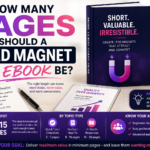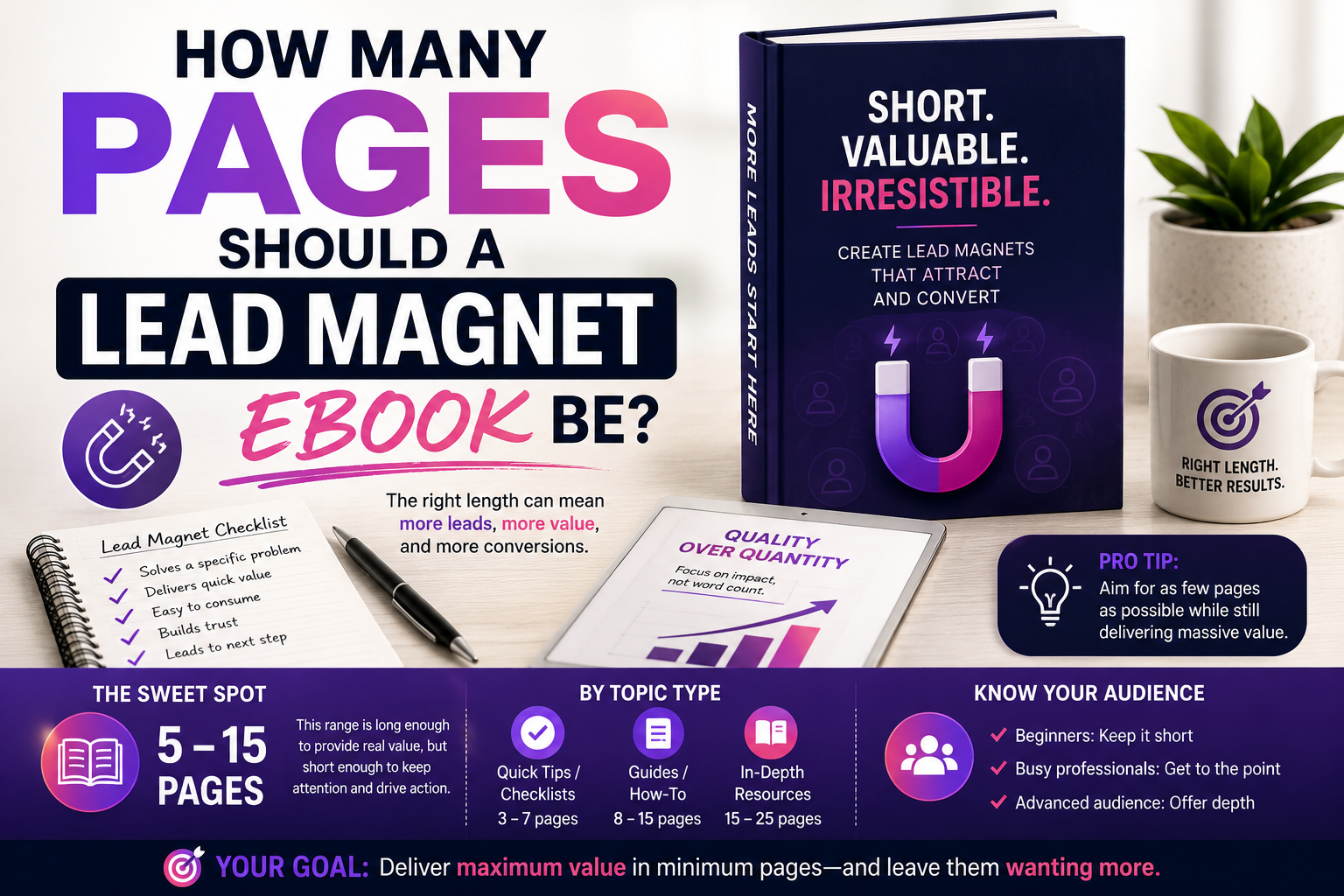
Quick answer: Most effective lead magnets run between 10 and 25 pages — enough to deliver one clear, complete outcome, but short enough that a reader can realistically finish it in a single sitting. Simple checklists or quick-start guides can work well at just 5–8 pages, while more detailed how-to guides or mini-courses can stretch to 30–40 pages without hurting conversion, as long as every page earns its place. The real mistake isn’t picking the wrong number — it’s padding a lead magnet with unnecessary length in an attempt to look more valuable, which usually backfires by lowering completion rates and, with them, trust in whatever you’re promoting next.
If that answer settles it for you, you’re ready to plan your page count and move on to writing. But the “right” length actually depends on a few specific factors worth understanding, since blindly aiming for a round number like “20 pages” without considering them can lead to a lead magnet that’s either too thin to feel valuable or too long to actually get read.
Why Page Count Isn’t the Real Question
The question “how many pages should my lead magnet be” is really a stand-in for a more useful one: how much content does it take to deliver on the promise made in your opt-in, and not one page more. A lead magnet isn’t judged by its length — it’s judged by whether the person who downloaded it feels like they got exactly what was promised, quickly and completely. Page count is just the byproduct of answering that question honestly.
This matters because both directions of getting it wrong carry real costs. A resource that’s too short to deliver its promised outcome feels like a bait-and-switch, damaging trust in everything you offer afterward. One that’s needlessly long dilutes a good idea with filler, and most readers simply won’t finish it — meaning the extra pages you spent time creating don’t just fail to add value, they actively reduce the odds the core message even gets read.
The Factors That Actually Determine the Right Length
1. How specific the promised outcome is
A narrow, specific promise (“5 email subject lines that get opened”) can be delivered completely in a handful of pages. A broader promise (“how to grow your email list”) implies more moving parts — multiple strategies, examples, and context — and naturally needs more room to feel complete. Match your page count to the actual scope of what you promised in your opt-in copy, not to an arbitrary target.
2. The format of the content itself
A checklist, a swipe file, or a template pack can meaningfully deliver its full value in 5–10 pages, since the value is in the tool itself, not surrounding explanation. A how-to guide walking through a multi-step process typically needs more room to explain each step properly — often 15–25 pages. A mini-course-style version of this, covering a broader skill across several stages, can reasonably run 25–40 pages if every section is genuinely necessary to the outcome.
3. Where your reader is in their journey with you
Someone encountering your brand for the first time generally benefits from a shorter, faster win — something that builds trust quickly without demanding a large time investment before they know if you’re worth listening to. A warmer audience, already following your content or on your email list, may be willing to engage with a longer, more detailed lead magnet, since some trust has already been established.
4. What happens next
If this piece is the first step in a nurture sequence leading toward a paid product, its job is to build trust and demonstrate expertise quickly — a shorter, highly focused piece often performs better here, since the goal is momentum toward the next step, not a complete standalone resource. If it’s instead meant to fully solve a specific, contained problem on its own (with no immediate follow-up funnel), a slightly longer, more complete treatment can make sense, since it’s not competing against a “for the full picture, buy this” motivation to keep things short.
Common Length Ranges by Format
These are practical starting points, not rigid rules — adjust based on the three factors above.
- Checklists, cheat sheets, swipe files: 3–8 pages
- Quick-start guides: 8–15 pages
- Standard how-to guides: 15–25 pages
- Templates with instructions: 10–20 pages
- Mini-courses or multi-step frameworks: 25–40 pages
- Resource lists or curated collections: 10–20 pages
Notice that even within this range, none of these categories reach the length of a full paid ebook, which is intentional — the job here is to deliver one specific, complete outcome quickly, not to be comprehensive in the way a paid product often needs to be.
Signs the Piece Is Too Long
- You’re including background information, personal stories, or context that doesn’t directly serve the promised outcome
- You could remove entire sections without the core promise becoming incomplete
- The introduction takes more than a page or two before delivering any real value
- You’re repeating the same point in different words to stretch the page count
- A reader would need 30+ minutes of focused reading to get through it, when the promised outcome could reasonably be delivered faster
Signs the Piece Is Too Short
- The promised outcome genuinely requires more explanation than you’ve given it, leaving the reader without enough to actually act on what they just read
- Steps are listed without enough detail to actually execute them
- It feels more like a teaser for a future paid product than something that stands on its own as genuinely useful on its own terms
- Readers who complete it are left with more questions than the piece answers, rather than a clear next action
A Practical Process for Deciding Your Page Count
- Write the promised outcome as one specific sentence — the more specific this sentence is, the more clearly you’ll know when the content genuinely fulfills it.
- Outline only what’s required to deliver that outcome, resisting the urge to add “just one more helpful section” that isn’t strictly necessary.
- Draft without worrying about final page count, focusing purely on covering the outcome completely.
- Review and cut ruthlessly — remove any section that doesn’t directly serve the promised outcome, regardless of how interesting it is on its own.
- Check the resulting length against the ranges above, not as a hard rule, but as a sanity check — if you’re dramatically outside the typical range for your format, it’s worth asking why.
A Practical Example
Imagine promising, in your opt-in copy, “a simple system to write a week’s worth of social media captions in 30 minutes.” A lead magnet delivering exactly that promise might run 10–12 pages: a short explanation of the system, a caption formula or template, three or four worked examples applying it to different scenarios, and a brief troubleshooting section for common sticking points. Padding this out to 35 pages with extended backstory, tangential general tips, or repeated encouragement doesn’t make the promise more fulfilled — it just makes the piece take longer to get through the same core value.
Now compare that to a broader promise: “everything you need to plan and launch your first online course.” That’s a genuinely bigger scope — covering topic selection, structuring content, choosing a platform, pricing, and launch marketing — and reasonably justifies 30–40 pages, since trying to compress that entire scope into 10 pages would leave each section too thin to actually be useful.
Length and Conversion: What the Data Generally Shows
While exact numbers vary by niche and audience, a consistent pattern shows up across marketing research on lead magnets generally: completion rate tends to drop as length increases, especially past the point where a reader can’t reasonably finish in one sitting. A shorter, fully completed lead magnet that delivers real value tends to build more trust — and generate better conversion into a next step — than a longer one that gets downloaded but abandoned halfway through. This is the practical reasoning behind favoring “as short as fully delivers the promise” over “as long as possible to seem valuable.”
How Formatting Affects Perceived Length
Two documents with the same word count can feel completely different in length depending on how they’re formatted. Dense paragraphs, small margins, and minimal visual breaks make even a short piece feel heavier and slower to get through. Generous white space, clear section breaks, bullet points for anything sequential, and a few well-placed visuals let the same content feel lighter and faster to move through, even at a slightly higher page count.
This matters directly for the length question, because it means two ten-page documents aren’t automatically equivalent — one might read in five minutes, the other in twenty, purely based on layout choices rather than content differences. When in doubt, favor more generous formatting over cramming content tightly to hit a lower page number; a slightly longer, well-formatted piece almost always outperforms a shorter, dense one in actual completion rates.
Testing Length Against Real Results
Since the ideal length depends on audience, format, and promise (as covered above), the most reliable way to confirm you’ve got it right isn’t a rule of thumb — it’s watching how your actual audience responds. A few practical signals worth tracking after you publish:
- Download-to-open rate, if your delivery method allows tracking whether people actually open the file after requesting it
- Direct feedback or replies, particularly if people mention finding it too long, too short, or exactly right
- Completion signals, where available, such as scroll depth on a hosted version or engagement with a follow-up email referencing specific later sections
- Conversion into your next step, since ultimately the length is only “right” if it supports the broader goal the resource exists to serve
If you have an earlier version at a different length, comparing these signals across versions is more informative than any general guideline, since it reflects your actual audience’s behavior rather than an industry average.
Frequently Asked Questions
Does a longer resource convert better as an opt-in offer? Not reliably. What tends to drive opt-in conversion is how clearly the promised outcome is communicated in your signup copy, not the eventual length of the content itself — readers decide to download based on the promise, and judge you afterward based on whether the length matched that promise appropriately.
Should a free opt-in ever be as long as a paid ebook? Generally no. Its job is to deliver one specific, complete outcome quickly, while a paid ebook typically covers more ground in more depth, which naturally justifies more length and a price attached to it.
Is it better to split a longer topic into a series of shorter pieces? Often yes, especially for broader topics — a short series lets each piece stay focused and completable, while also giving you more natural opportunities to stay in touch with a subscriber across multiple emails rather than one single download.
What if my promised outcome genuinely needs more than 40 pages to deliver? That’s usually a sign the offer itself is better suited to a paid ebook or course rather than a free download — a lead magnet promising something that large in scope for free often signals the free version doesn’t actually deliver on it as completely as it initially sounds.